Showing posts with label Art. Show all posts

Tuesday, August 21, 2012

Why head for the Med when you can spend August in Paris?


Paris' last remaining vineyard, Montmartre
Contrary to popular belief, not all of Paris closes down during the month of August. What does happen, though, is that as soon as July nears its end thousands and thousands of Parisians flee the city for their second homes in the country or on the coast.  And, let’s be honest, what could be more pleasurable than Paris without Parisians?

The city's residents, both young and old, are noticeably friendlier, more “cool” and “zen” as the French themselves put it, during August. Sure, some of the cafés and restaurants (and seemingly all of the boulangeries) pull down their shutters for the month, but just as many stay open. And though the main tourist sites – the Eiffel Tower, the Sacré Coeur, Paris Plage – still teem with foreign visitors, the morning streets are deserted. 

Sunday, August 29, 2010

Monet Exhibition in Paris

This year Richard Thomson took his holidays in June. Difficult to do otherwise, since he's the chief curator of the Claude Monet exhibition that opens in Paris' Grand Palais on September 22nd. With 176 works of art, the exhibition promises to be a major event. And so we might have expected to encounter a worried man. 

Is it the result of a breezy disposition or is it the natural Anglo-Saxon discretion of a professor at the University of Edinburgh? The morning we meet, it is as much as he can do to admit that he still has a few small jobs to finish before the fateful day.

To listen to Richard Thomson, everything is being carried out without a hitch and on good terms with the French curators who are helping him. The catalogue? The entries were submitted on time and they are of good quality. The design of the exhibition space? He is relying on the ideas of Hubert Le Gall, with whom plain-speaking is the rule. The hanging of the pictures? The plan was fixed long ago using computer simulations.

Calculated to the nearest tenth of an inch

On this point, however, Mr Thomson admits that his happiness is not complete. He yearns for the time when hanging was not calculated to the nearest tenth of an inch weeks before the arrival of the paintings, when the curator and a few assistants positioned the canvases "by eye", taking them from room to room until the desired effect was achieved. "That's impossible today. Can you imagine, with the cost of insurance? They would think that we were being irresponsible". Each Monet, then, already has its spot reserved.

This is even more the case because the exhibition has been designed to follow a very complex structure: "That's the key feature of my work: to think about the best way of showing a painting, not settling for an ordinary, boring retrospective where the masterpieces come one after another in chronological order from beginning to end. It has been about giving a new image of Monet, about sparking off new debates".

And so begins Thomson's account of how he first thought about the history of the exhibition: "I thought that 1890 should be the pivotal date. Monet was 50 in 1890. He arrives at Giverny. The art dealers are becoming more and more interested in him. And it's the start of his series. There is a before and an after 1890. That's the central idea. The first section comprises French landscapes before this date, the links between their creation and nature: the canvases from Fontainebleau, Normandy, the region around Paris, Vétheuil and two places further away, Belle Ile and the Creuse region. At the end of this part, I wanted a very clear break. There will be two rooms, one devoted to the human form in the years 1870 and 1880, the other to still-lifes. I preferred to do that - rather than scatter figures and still-lifes everywhere - to show that, for Monet, these are important subjects.  Then the second section, the years after 1890, begins".

You only need to hear the historian's voice to sense how important it is for him to convince the listener of the appropriateness of his scheme. His explanation is already well-polished. There will be, then, another three subjects, with the themes of repetition, inner nature and adornment. Haystacks and Poplars will appear in the first, Vétheuil and Venice in the second, Giverny and her water-lilies in the last.

Once the order was established, all that remained was the paintings themselves. Everything went well, perhaps even too well. "At the end of 2009, the museums started to reply. All the responses were positive.. In fact, there were too many paintings. Towards Christmas, we knew that we were going to have to make some sacrifices. I had started with the idea of 200 paintings but it became clear that we'd have to go down to 175 so that there would be enough space left for visitors". But how does he explain so many loans? "The American museums have been very forthcoming... New York, Boston... They're used to working with the Orsay and that helped with the negotiations".

No setbacks, then? "Unfortunately, yes. The Marmottan Museum refused to lend, Impression, Rising Sun", the historic work to which Impressionism owes its name. "But it's not too serious. They will be some less well-known paintings whose discovery will to a large extent compensate for its absence. We suggested some exchanges but, clearly, it wasn't possible. In its place you will see a view of the port of Le Havre from 1873, a night scene, an extraordinary one, that has come from a private collection".

Having worked so long on Monet, what has he learned? "That you have actually to go to the places where he painted to be able to understand him". So the museum man got lost in a forest in the Creuse: "I wanted to find the spot where Monet had painted the confluence of two rivers in 1889 - he painted it ten times. Today, there are trees everywhere. I couldn't see the river any longer. Nothing corresponded to the paintings. Monet had gone there at a time when the peasants had stripped the wood for heating and when their herds of goats were grazing on the under-growth. The hills were bare. Today, it's a forest. I finished by finding my bearings thanks to a rock... I started again at Belle Ile so that I could identify the exact viewpoint over the needles of Port Coton. Just at the edge of the cliff, about 50 yards away. That's what organising a Monet exhibition drives you to!"


This article first appeared in Le Monde, August 17 2010; it was translated from the French by Culturissima's managing director, Dr David Winter.

Friday, August 27, 2010

Her body, muscular and almost masculine, bathed in light...

The Venus de Milo brings a smile to the Louvre

According to legend, Venus - known to the Greeks as Aphrodite - was born from the foam of the sea as she emerged from bathing off the coast of Cyprus. Be that as it may, the goddess of love serves as the model for the canon of beauty, an ideal epitomised in the Louvre's Venus de Milo.

The famous statue has just been restored, which comes as a pleasant surprise to the six million people (out of a total of eight million) who visit the Louvre each year with the stated aim of admiring the Venus de Milo together with the museum's two other jewels, Leonardo de Vinci's Mona Lisa and the Victory of Samothrace. The Venus, sculpted from white marble from Paros circa 120 BC, was found in 1820 by a peasant on the Greek island of Milos in the Cyclades and was given to the Louvre by King Louis XVIII in 1821.

This summer, the statue is radiating good health.  Her body, muscular and almost masculine, bathed in the light streaming in from the south-facing windows, has recovered the milky lustre of its origins. So, too, its energy and aura next to the gods and goddesses who surround it, Athena, Apollo, Hermes, Dionysus and others - Roman copies of lost Greek chefs d'oeuvres.

The smile that plays across her left cheek, almost teasing, contrasts sharply with the serious look sketched across her right side. The subtle folds of her toga, which could easily be made of real linen, fall to her hips and reveal a perfect bust.

Positioned in the centre of a carpet of red marble and mounted on a plinth (it is possible to walk all the way around her and view her from all angles), the Venus de Milo, six-and-a-half feet tall, stands sentinel over the 2,000 square feet of former royal apartments as they stretch towards the caryatids gallery.  She is the crowning feature of a new museum lay-out devoted to classical Greek and Hellenistic art (450-30 BC) devised by Jean-Luc Martinez (director of the Louvre's department of Greek, Etruscan and Roman antiquities) as a three-dimensional walk amongst the works of art.

Where are her arms?

At the head of the world's foremost museum of Greek art, totalling more than 45,000 objects, Jean-Luc Martinez has for the first time put on display works taken from the museum's reserve holdings or dispersed in other departments (ceramics, jewellery, numismatics, furniture). From now on these will be presented by geographic region to showcase the world of the Greek Mediterranean.

As for the Venus de Milo, she has once more found the place that she occupied from 1824 to 1848.  Since she first entered the Louvre, she has never ceased to be moved about. In the 1820s, following a controversy, it was decided not to attach the missing arms that had been sculpted for the occasion. Only her nose, left foot and big toe were re-attached.

"Whilst removing the old restoration work we noticed that the surface had been prepared for a marble adjunct that was never finished", indicates Monsieur Martinez. In 2009-2010 a scientific study brought to light the alterations and repairs that have been undertaken over two centuries.  It was decided to keep her nose, but not her foot. Fragments of marble are displayed around the goddess, including an outsized hand, which nourish the enigma... her arms are still unaccounted for.


This article first appeared in Le Monde, August 20 2010; it was translated from the French by Culturissima's managing director, Dr David Winter.

Saturday, May 1, 2010

The Norwich school

Am just about to head off to Norwich, in East Anglia, to do a "recce" on the Norwich school of painters for a British client. The 19th century Norwich School, whose landscapes and seascapes recall the realism of Dutch 17th century painting, can justifiably claim to be the only regional art movement that England has ever known. If the father of the "Norwich Society of Artists" was John Crome, then its leading exponent was John Sell Cotman, widely regarded as one of the country’s most accomplished water-colourists.

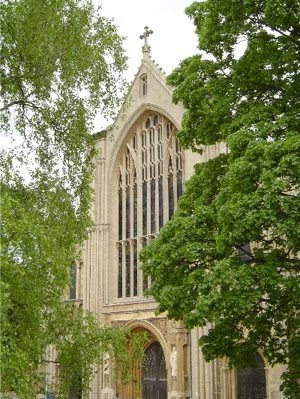
Norwich Cathedral
I'm going to look at some of the finest œuvres of the Norwich School and examine how the Norfolk countryside, its broads and rivers, inspired Crome and his fellow artists.  

Norwich Castle Museum and Art Gallery, the beneficiary of a lavish £12 million refit, hosts the most comprehensive collection of the work of the Norwich School. Alongside paintings by John Crome they have an unrivalled anthology of oils and water-colours by John Sell Cotman as well as landscapes by Robert Ladbrooke, James Stark and Crome's two sons, John Berney Crome and William Henry Crome.  Other local painters represented in the museum include Sir Alfred Munnings and Edward Seago.  

Henry Moore at Sainsbury's
So much for my background research - all that was new to me. What I did know, from previous visits to the region, is that Norwich’s fascination stretches far beyond its eponymous art school: the Sainsbury Centre celebrates the genius of Henry Moore, Giacometti, Bacon, Picasso and Modigliani, whilst Jacobean Blickling Hall evokes an altogether different era.  Reputedly home to the headless ghost of Anne Boleyn, Blickling is hung with family portraits by Gainsborough and boasts a splendid “Peter the Great Room”, which commemorates the service of the Earl of Buckinghamshire as ambassador to Russia.

Monday, February 2, 2009

I am the great lion of the day

Part of Culturissma's monthly schedule is to brief our clients on up-coming art exhibitions so that they can steal a march on their rivals. We've just got wind of a new offering at London's Tate BritainTurner and the Masters, which will be the first ever exhibition to examine the influence of the Old Masters on J M W Turner.  As well as displaying some of Turner's most scintillating canvases, Turner and the Masters will showcase around 100 works by Canaletto, Poussin, Rubens, Rembrandt and Constable.

Born in 1775, Turner - the London-born son of a barber - was always confident of his abilities, once proclaiming: "I am the real lion. I am the great lion of the day". The Tate exhibition will investigate the complexity of Turner's obsession with the Old Masters as he strove first to imitate, then rival and finally surpass the style of Rubens, Rembrandt and Claude Lorrain.  Acts of homage will hang alongside sophisticated forms of art criticism in an exhibition that is likely to re-establish Turner's reputation as the greatest painter of landscape in the European tradition.

Friday, January 2, 2009

Pierre-Auguste Renoir in Paris

One of Renoir's former homes in Montmartre,
with the Sacré Coeur in the background
I have the good fortune to live among the cobbled streets of Montmartre, within rioting distance of the Sacré Coeur and just a fifteen minute bicycle ride - all downhill - to the Louvre and the Musée d’Orsay.    My apartment overlooks a narrow, winding road that was painted by, amongst others, Cézanne, Picasso, van Gogh and the unfortunate Utrillo.

Lodged on the corner of our narrow lane is the pink façade of the famous Lapin Agile bistro, where the likes of Picasso, Utrillo, Derain, Braque and Modigliani once held court. It’s in this bar, formerly known as the Cabaret des Assassins, that a donkey once painted a canvas - Sunset on the Adriatic Sea - that ended up being hung in the prestigious annual Salon des Independents! It’s a lovely spot, too, to open a bottle of wine in the early evening in summer, as the sun comes streaming down the hill.

Picasso is never far from our thoughts here in Montmartre: to reach my local bar, I meander down the southern slopes of the hill past the Laundry Boat - Le Bateau Lavoir - where he once lived and painted.   There's another, more personal, connection, too: I bought my apartment from a chap - the make-up artist for President Mitterand's wife, as it happens - whose new next door neighbour, just five minutes away, is Picasso's former lover and the mother of his children, Claude and Paloma.  Her name is Francoise Gilot and, though Picasso died in 1973, Mme Gilot is still very much alive and kicking - and painting, too, as she is a celebrated painter in her own right.

Anyway, at the moment Culturissima is busy setting up two art tours for a major British client, a company that runs cultural and historic programmes across the world. The first tour is called "In The Footsteps of The Impressionists" and the second, "Renoir in Paris".  

The latter has been timed to coincide with a Renoir retrospective, Les Dernières Années, that will be held at the Grand Palais, just off the Champs Elysées, at the end of 2009.  This exhibition, details of which have yet to be released to the general public, will concentrate on the final period of Renoir's life when his nudes, later to influence Bonnard, Matisse and Picasso, drew their inspiration from the Old Masters.

Renoir's house in autumn, with
the Montmartre vineyard in the foreground
Although born in Limoges, Renoir se considérait comme un Parisien, according to his son. He lived part of his childhood alongside the former Tuileries Palace - and even used to disturb the Queen of France with his games! - before eventually settling in bucolic Montmartre, a world away from the new Paris of the demolition man, Baron Haussmann. One of Renoir’s first houses was in rue Cortot, now a museum and it was on the hill of Montmartre, with its vineyard, windmills and sweet-smelling gardens, that Renoir painted and here one can still see the Moulin de la Galette, the windmill immortalised in the eponymous painting on display at the Musée d'Orsay.  

Tuesday, November 11, 2008

The Old Women and the Young Women

Culturissima has just returned from two days in northern France on behalf of one of our British clients, a travel agency based just outside Cambridge that wants to put together a tour of Lille and its environs.

What are we going to report back?

First, that Goya’s twin canvases The Old Women and The Young Women are enough in themselves to attract the art-lover to northern France.  Yet Lille, where Flemish tradition meets French culture, and Valenciennes, the birthplace of Antoine Watteau, have many other exquisite treasures on display.

Lille’s Palais des Beaux Arts hosts the most valuable gathering of art in France outside Paris - not just the magnificent Goyas but also an outstanding collection of Old Master pictures and sculpture with work by Donatello, Rubens, van Dyck and Jordaens. The galleries also house an impressive selection of French 18th and 19th century gems with major œuvres by Jacques-Louis David. A short distance away lies the 13th century Hospice Comtesse, hung with 15th to 18th century paintings together with tapestries by Guillaume Werniers.

Valenciennes’ Musée des Beaux Arts pays ample tribute to the creative talent of the town’s two most famous sons, Watteau and Jean-Baptiste Carpeaux. The museum is also the setting for a notable group of Flemish 17th century paintings, in particular Rubens triptych of St Etienne and Descent from the Cross.

The focal point of our afternoon in the cathedral town of Tournai was the Musée des Beaux Arts, designed by the Belgian art nouveau architect Victor Horta. The museum’s holdings stretch from the early Flemish tradition to Monet and Seurat.   And our final day was spent re-visiting the Museum of Modern Art in Villeneuve d’Ascq, set in a verdant sculpture park and endowed with prized work by Picasso, Braque, Modigliani and Miro.