For the first decade of its existence, Culturissima was commissioned largely to write and research in the fields of the fine arts and architecture, music and the theatre, as well as archaeology and the natural world.
More recently, however, we've been asked to broaden our portfolio, to embrace the history of the First and Second World Wars, with one of our latest pieces appearing under the title of The Battle of The Atlantic and British Bunkers.
In this anniversary year, of course, the First World War still resonates deeply in the British psyche, and we've just finished putting the finishing touches to an article on the Somme for a British client; here's a taste:
The detonating of the mine at Hawthorn Ridge on the morning of July 1, 1916 marked the advent of the darkest day in the history of the British Army, a covenant with death that saw 58,000 British troops killed or wounded before nightfall.
By the time the Somme offensive came to an end four and half months later, the lives of more than a million men - British, Commonwealth, French and German - were shattered.
As well as treading lightly over the physical relics of the Somme battlefields - the trenches, shell holes and mine craters - our journey to northern France echoed to the musical strains of the Great War, from the 1914 recruiting refrain "Oh, we don't want to lose you but we think you ought to go" to Ivor Novello's Keep the Home-Fires Burning:
They were summoned from the hill-side;
They were called in from the glen,
And the Country found them ready
At the stirring call for men.
Showing posts with label England. Show all posts
Showing posts with label England. Show all posts
Tuesday, January 7, 2014

Saturday, May 1, 2010
The Norwich school
Am just about to head off to Norwich, in East Anglia, to do a "recce" on the Norwich school of painters for a British client. The 19th century Norwich School, whose landscapes and seascapes recall the realism of Dutch 17th century painting, can justifiably claim to be the only regional art movement that England has ever known. If the father of the "Norwich Society of Artists" was John Crome, then its leading exponent was John Sell Cotman, widely regarded as one of the country’s most accomplished water-colourists.
I'm going to look at some of the finest œuvres of the Norwich School and examine how the Norfolk countryside, its broads and rivers, inspired Crome and his fellow artists.
So much for my background research - all that was new to me. What I did know, from previous visits to the region, is that Norwich’s fascination stretches far beyond its eponymous art school: the Sainsbury Centre celebrates the genius of Henry Moore, Giacometti, Bacon, Picasso and Modigliani, whilst Jacobean Blickling Hall evokes an altogether different era. Reputedly home to the headless ghost of Anne Boleyn, Blickling is hung with family portraits by Gainsborough and boasts a splendid “Peter the Great Room”, which commemorates the service of the Earl of Buckinghamshire as ambassador to Russia.
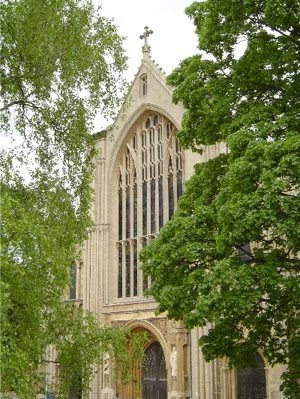 |
| Norwich Cathedral |
Norwich Castle Museum and Art Gallery, the beneficiary of a lavish £12 million refit, hosts the most comprehensive collection of the work of the Norwich School. Alongside paintings by John Crome they have an unrivalled anthology of oils and water-colours by John Sell Cotman as well as landscapes by Robert Ladbrooke, James Stark and Crome's two sons, John Berney Crome and William Henry Crome. Other local painters represented in the museum include Sir Alfred Munnings and Edward Seago.
 |
| Henry Moore at Sainsbury's |
Sunday, April 4, 2010
The key to England
Culturissima has recently been commissioned to write and research a series of cultural and historical tours for English Heritage and one of their partners. It’s been a source of great joy to investigate parts of England that we haven’t travelled to in recent years – particularly the south-east.
The English Channel and the south-east coast of England have always played a pivotal role in the defence of our Great Britain. Dover Castle, site of a Roman pharos that dates back to the 1st century AD, was long known as “the key to England”, and both Napoleon and Hitler earmarked these southern shores for sea-borne invasion. And, of course, where they failed, William the Conqueror succeeded – the itinerary that we have devised for English Heritage will begin at the very spot where Harold met his end in 1066.
The Western Heights, rising to the west of Dover and surrounded by chalk meadows, form the largest Napoleonic defences ever constructed in Britain. The most substantial fortifications were erected in the early years of the 19th century as a bulwark against French attack, and the redoubt later sheltered a squad of commandos during World War II.
The castles at Rye, Bodiam, Walmer and Deal each have their own tale to tell, but it is Dover Castle, fortified by Henry II, that takes pride of place. It was from the citadel’s secret tunnels, originally hewn to counter the threat of Napoleonic France, that Churchill and vice-admiral Ramsay masterminded the evacuation from Dunkirk. By the end of World War II, this labyrinthine complex had been developed into a veritable underground city, housing not just a military headquarters but also a hospital and substantial barracks.
The English Channel and the south-east coast of England have always played a pivotal role in the defence of our Great Britain. Dover Castle, site of a Roman pharos that dates back to the 1st century AD, was long known as “the key to England”, and both Napoleon and Hitler earmarked these southern shores for sea-borne invasion. And, of course, where they failed, William the Conqueror succeeded – the itinerary that we have devised for English Heritage will begin at the very spot where Harold met his end in 1066.
The Western Heights, rising to the west of Dover and surrounded by chalk meadows, form the largest Napoleonic defences ever constructed in Britain. The most substantial fortifications were erected in the early years of the 19th century as a bulwark against French attack, and the redoubt later sheltered a squad of commandos during World War II.
The castles at Rye, Bodiam, Walmer and Deal each have their own tale to tell, but it is Dover Castle, fortified by Henry II, that takes pride of place. It was from the citadel’s secret tunnels, originally hewn to counter the threat of Napoleonic France, that Churchill and vice-admiral Ramsay masterminded the evacuation from Dunkirk. By the end of World War II, this labyrinthine complex had been developed into a veritable underground city, housing not just a military headquarters but also a hospital and substantial barracks.
Thursday, December 17, 2009
F N Born 12 May 1820, Died 13 August 1910
At the moment I am putting together a collection of historical and cultural tours, many of which have a strong biographical element, for a British heritage organisation.
Next year (2010) sees the 100th anniversary of the death of a veritable heroine, Florence Nightingale. I've begun researching Florence’s life, and one of the first things that has struck me is Nightingale's strangely silent grave, where the memorial for one of the 19th century’s most lauded figures is no more eloquent than:
F.N. Born 12 May 1820, Died 13 August 1910.
"A wild swan" to her mother, "the lady with the lamp" to the readers of the contemporaneous Illustrated London News, the founder of modern nursing was many things: a tireless campaigner, an accomplished mathematician and statistician, and, I’ve just discovered, even the author of a novella, Cassandra.
Following in Nightingale’s footsteps has led me to stumble on one of London’s most unexpected curiosities. I already knew about the newly-extended Florence Nightingale Museum, located on the site of the pioneering nursing school that she founded at St Thomas’ Hospital in 1860. But the remains of the original St Thomas’ - named after Thomas Becket and Thomas the Apostle - lie eastwards around a bend in the Thames. Tucked away at the top of a rickety spiral staircase in the attic of St Thomas’s Church is England’s oldest surviving operating theatre, constructed in 1822, and, believe me, it doesn’t require much imagination to hear the screams of those pre-anesthetic days! Equally fascinating is the lonely garret used by the hospital’s apothecary to store and cure the medicinal herbs used during the operations.
Next year (2010) sees the 100th anniversary of the death of a veritable heroine, Florence Nightingale. I've begun researching Florence’s life, and one of the first things that has struck me is Nightingale's strangely silent grave, where the memorial for one of the 19th century’s most lauded figures is no more eloquent than:
F.N. Born 12 May 1820, Died 13 August 1910.
"A wild swan" to her mother, "the lady with the lamp" to the readers of the contemporaneous Illustrated London News, the founder of modern nursing was many things: a tireless campaigner, an accomplished mathematician and statistician, and, I’ve just discovered, even the author of a novella, Cassandra.
Following in Nightingale’s footsteps has led me to stumble on one of London’s most unexpected curiosities. I already knew about the newly-extended Florence Nightingale Museum, located on the site of the pioneering nursing school that she founded at St Thomas’ Hospital in 1860. But the remains of the original St Thomas’ - named after Thomas Becket and Thomas the Apostle - lie eastwards around a bend in the Thames. Tucked away at the top of a rickety spiral staircase in the attic of St Thomas’s Church is England’s oldest surviving operating theatre, constructed in 1822, and, believe me, it doesn’t require much imagination to hear the screams of those pre-anesthetic days! Equally fascinating is the lonely garret used by the hospital’s apothecary to store and cure the medicinal herbs used during the operations.
Tuesday, September 1, 2009
Pockets of England II
I take that back.
Having previously written that it's the unknown treasures of the south-east of England that have most fascinated me over the last few weeks, I now think that the south-west has as much - if not more - to offer the cultural traveller.
Devon seems to have everything, from the vast expanses of Dartmoor to small towns and villages such as Sidmouth and Budleigh Salterton. What's equally amazing is that the tranquil countryside is so easily accessible: within five minutes of leaving Exeter airport, for example, you find yourself driving through country lanes past traditional English pubs - a world away from the hustle and bustle of Paris, where our journey had started just over an hour earlier.
South Devon is graced with a generous collection of small manor houses, many of them privately-owned and seldom-visited.
Mothecombe, blessed with an estate running down to the sea, is a perfect Queen Anne doll's house with later additions by Sir Edwin Lutyens, whilst Sharpham, set in a Capability Brown landscape overlooking the River Dart, is an exquisite Palladian villa by Sir Robert Taylor.
Having previously written that it's the unknown treasures of the south-east of England that have most fascinated me over the last few weeks, I now think that the south-west has as much - if not more - to offer the cultural traveller.
Devon seems to have everything, from the vast expanses of Dartmoor to small towns and villages such as Sidmouth and Budleigh Salterton. What's equally amazing is that the tranquil countryside is so easily accessible: within five minutes of leaving Exeter airport, for example, you find yourself driving through country lanes past traditional English pubs - a world away from the hustle and bustle of Paris, where our journey had started just over an hour earlier.
South Devon is graced with a generous collection of small manor houses, many of them privately-owned and seldom-visited.
Mothecombe, blessed with an estate running down to the sea, is a perfect Queen Anne doll's house with later additions by Sir Edwin Lutyens, whilst Sharpham, set in a Capability Brown landscape overlooking the River Dart, is an exquisite Palladian villa by Sir Robert Taylor.
Wednesday, August 19, 2009
Is it cheating?
Returning, very briefly, to the idea that the Brits might be more "aspirational" than the French, the two countries certainly have different codes of behaviour when it comes to things sportif.
So, for example, in beating Paris to secure the right to host the next Olympic Games, London clearly cheated. How? Because Lord Coe and his team - "perfide Albion" to the French - lobbied behind the scenes.
They did what? Um, yes, they went out of their way to chat up the presidents of the other Olympic committees.
Then, during the last Tour de France, the British cyclist Mark Cavendish, who won six stages on French territory, was guilty of something very close to cheating in French eyes.
What did Cavendish do? He took drugs? No. But his experience as a youngster as a track cyclist - where it’s possible to develop a very explosive style - gave Cavendish an unfair advantage in the mass sprint finishes that characterised this year’s Tour de France. And, what’s more, he had the best team on his side.
I’ve given up trying to put the Brit point of view: that, in both of the above cases, it’s the professionalism of Coe and Cavendish that helped them secure their prizes. You can’t win races on skill and innate talent alone - you have to have aspirations to go beyond what you were born with. In a sense, it’s your duty to do everything you can - legally - to win, isn’t it, if you’re in the position of professionals such as Coe and Cavendish?
“Ah”, reply my French friends, “but you don’t have more skill than us, just more money…”
So, for example, in beating Paris to secure the right to host the next Olympic Games, London clearly cheated. How? Because Lord Coe and his team - "perfide Albion" to the French - lobbied behind the scenes.
They did what? Um, yes, they went out of their way to chat up the presidents of the other Olympic committees.
Then, during the last Tour de France, the British cyclist Mark Cavendish, who won six stages on French territory, was guilty of something very close to cheating in French eyes.
What did Cavendish do? He took drugs? No. But his experience as a youngster as a track cyclist - where it’s possible to develop a very explosive style - gave Cavendish an unfair advantage in the mass sprint finishes that characterised this year’s Tour de France. And, what’s more, he had the best team on his side.
I’ve given up trying to put the Brit point of view: that, in both of the above cases, it’s the professionalism of Coe and Cavendish that helped them secure their prizes. You can’t win races on skill and innate talent alone - you have to have aspirations to go beyond what you were born with. In a sense, it’s your duty to do everything you can - legally - to win, isn’t it, if you’re in the position of professionals such as Coe and Cavendish?
“Ah”, reply my French friends, “but you don’t have more skill than us, just more money…”
Tuesday, August 18, 2009
Hairy, club-carrying and wood-dwelling
As well as unearthing the story of Florence Nightingale, my current work for Culturissima and English Heritage has been introducing me to a handful of historical figures whom I was previously only dimly aware of.
One of my favourite discoveries is General Augustus Pitt Rivers (1827-1900), a soldier and archaeologist extra-ordinaire. Widely considered the father of modern British archaeology, the General was also a committed philanthropist: from the early 1890s onwards he set about designing Larmer Tree Gardens,"an extraordinary example of Victorian extravagance and vision" set in the heart of Dorset, south-west England.
Pitt Rivers created Larmer for the delectation and delight of the general public, and, as well as admiring the parkland, pagodas and free-flying parrots, it’s also possible to visit some of the ancient burial sites and villages unearthed by Pitt Rivers. A modern equivalent of Pitt Rivers is Martin Green, one of Dorset’s foremost field archaeologists, whose private museum at Down Farm houses the archaeological remains that Green has excavated on his land over the past 40 years.
Sir Robert Walpole (1676-1745) is another of the colourful characters who has been populating my working life (and dreams!) over the past couple of weeks. Walploe is a British politician who dominated parliament for over two decades; in fact, he’s generally regarded as Britain's first prime minister.
Born at Houghton Hall in Norfolk, one of England’s grandest country houses, and later educated at Eton and Cambridge, Walpole was the first prime minister to live and work at 10 Downing Street. Life wasn’t always so easy for Sir Bob, though: ridiculed as Sir Blustering by his enemies, he sailed closed to corruption on more than one occasion and even spent six months marooned in the Tower of London.
My favourite encounter of the last few weeks, though, hasn’t been with an archaeologist or politician.
Hairy, club-carrying and wood-dwelling, the wild man or "woodwose" is a familiar figure in mediaeval art and literature. Part-man, part-beast, he - and sometimes even she - can still be seen going about his daily business, whether it’s hunting lions with a Herculean club or throwing a pagan stare over a congregation of Christians. The wild man is carved into the very fabric of Norfolk and Suffolk: the region’s early churches and historic houses, even its heraldic coat of arms, bear fertile witness to the potency of the woodwose. East Anglia is still alive, too, with tales of beasts and monsters - including the 12th century wild man of Orford:
Men fishing in the sea caught in their nets a wild man. He was naked and was like a man in all his members, covered with hair and with a long shaggy beard. Brought into church, he showed no signs of reverence or belief.
One of my favourite discoveries is General Augustus Pitt Rivers (1827-1900), a soldier and archaeologist extra-ordinaire. Widely considered the father of modern British archaeology, the General was also a committed philanthropist: from the early 1890s onwards he set about designing Larmer Tree Gardens,"an extraordinary example of Victorian extravagance and vision" set in the heart of Dorset, south-west England.
Pitt Rivers created Larmer for the delectation and delight of the general public, and, as well as admiring the parkland, pagodas and free-flying parrots, it’s also possible to visit some of the ancient burial sites and villages unearthed by Pitt Rivers. A modern equivalent of Pitt Rivers is Martin Green, one of Dorset’s foremost field archaeologists, whose private museum at Down Farm houses the archaeological remains that Green has excavated on his land over the past 40 years.
Sir Robert Walpole (1676-1745) is another of the colourful characters who has been populating my working life (and dreams!) over the past couple of weeks. Walploe is a British politician who dominated parliament for over two decades; in fact, he’s generally regarded as Britain's first prime minister.
Born at Houghton Hall in Norfolk, one of England’s grandest country houses, and later educated at Eton and Cambridge, Walpole was the first prime minister to live and work at 10 Downing Street. Life wasn’t always so easy for Sir Bob, though: ridiculed as Sir Blustering by his enemies, he sailed closed to corruption on more than one occasion and even spent six months marooned in the Tower of London.
My favourite encounter of the last few weeks, though, hasn’t been with an archaeologist or politician.
Hairy, club-carrying and wood-dwelling, the wild man or "woodwose" is a familiar figure in mediaeval art and literature. Part-man, part-beast, he - and sometimes even she - can still be seen going about his daily business, whether it’s hunting lions with a Herculean club or throwing a pagan stare over a congregation of Christians. The wild man is carved into the very fabric of Norfolk and Suffolk: the region’s early churches and historic houses, even its heraldic coat of arms, bear fertile witness to the potency of the woodwose. East Anglia is still alive, too, with tales of beasts and monsters - including the 12th century wild man of Orford:
Men fishing in the sea caught in their nets a wild man. He was naked and was like a man in all his members, covered with hair and with a long shaggy beard. Brought into church, he showed no signs of reverence or belief.
Wednesday, May 13, 2009
Pockets of England I
In spite of the pervasiveness of mass tourism, it still requires little effort to delve into pockets of England, Scotland and Wales that remain little-visited and little-known. Maybe it's because, until the recent "credit crunch", the British preferred to holiday abroad than set out in discovery of the cultural delights of their own island.
I'm in the middle of finishing an assignment that has taken me as far north as the Highlands of Scotland and as far south of the Scilly Isles. It's the south-east corner of England that has fascinated me the most, though.
From the subterranean vestiges of Roman Canterbury to the Bacchic frescoes of Dover's Painted House, Kent is steeped in Roman history. Richborough was probably the site of Claudius' invasion of Britain in AD 43, whilst the coastal fort at Reculver stood sentinel over a chain of fortifications that once stretched from the Isle of Wight to the Wash.
Dover Castle, recently restored by English Heritage, is one of my favourite "discoveries", as it has allowed me to re-read the story of Henry II and his wicked treatment of Thomas Becket, archbishop of Canterbury. Henry re-built Dover Castle at great expense to accommodate wealthy pilgrims on their way to the shrine of Becket, the very man (this "turbulent priest") he had murdered!
South Wales, seldom explored by the cultural travaller, boasts some of Britain's most rewarding Roman monuments and mediaeval remains. Caerleon, for example, is the best preserved legionary fortress in the western Roman empire. Founded in AD 75, ancient Isca - once the base of the Second Augustan Legion - bears substantial traces of its illustrious past: fortified defences, barracks, baths and a military amphitheatre extensively excavated by Mortimer Wheeler.
Then, in the far north, Northumbria is home to the twin Anglo-Saxon monasteries at Monkwearmouth and Jarrow, the United Kingdom's nomination for UNESCO World Heritage status in 2010.
I'm in the middle of finishing an assignment that has taken me as far north as the Highlands of Scotland and as far south of the Scilly Isles. It's the south-east corner of England that has fascinated me the most, though.
From the subterranean vestiges of Roman Canterbury to the Bacchic frescoes of Dover's Painted House, Kent is steeped in Roman history. Richborough was probably the site of Claudius' invasion of Britain in AD 43, whilst the coastal fort at Reculver stood sentinel over a chain of fortifications that once stretched from the Isle of Wight to the Wash.
Dover Castle, recently restored by English Heritage, is one of my favourite "discoveries", as it has allowed me to re-read the story of Henry II and his wicked treatment of Thomas Becket, archbishop of Canterbury. Henry re-built Dover Castle at great expense to accommodate wealthy pilgrims on their way to the shrine of Becket, the very man (this "turbulent priest") he had murdered!
South Wales, seldom explored by the cultural travaller, boasts some of Britain's most rewarding Roman monuments and mediaeval remains. Caerleon, for example, is the best preserved legionary fortress in the western Roman empire. Founded in AD 75, ancient Isca - once the base of the Second Augustan Legion - bears substantial traces of its illustrious past: fortified defences, barracks, baths and a military amphitheatre extensively excavated by Mortimer Wheeler.
Then, in the far north, Northumbria is home to the twin Anglo-Saxon monasteries at Monkwearmouth and Jarrow, the United Kingdom's nomination for UNESCO World Heritage status in 2010.
Monday, February 2, 2009
I am the great lion of the day
Part of Culturissma's monthly schedule is to brief our clients on up-coming art exhibitions so that they can steal a march on their rivals. We've just got wind of a new offering at London's Tate Britain, Turner and the Masters, which will be the first ever exhibition to examine the influence of the Old Masters on J M W Turner. As well as displaying some of Turner's most scintillating canvases, Turner and the Masters will showcase around 100 works by Canaletto, Poussin, Rubens, Rembrandt and Constable.
Born in 1775, Turner - the London-born son of a barber - was always confident of his abilities, once proclaiming: "I am the real lion. I am the great lion of the day". The Tate exhibition will investigate the complexity of Turner's obsession with the Old Masters as he strove first to imitate, then rival and finally surpass the style of Rubens, Rembrandt and Claude Lorrain. Acts of homage will hang alongside sophisticated forms of art criticism in an exhibition that is likely to re-establish Turner's reputation as the greatest painter of landscape in the European tradition.
Friday, August 8, 2008
Having fun in Paris and London
 |
| Puppy love in a Paris bar |
Or maybe your "average" French madame or monsieur is aspirational in a way that my Anglo-Saxon mind can't quite fathom?
I've just come back to Paris from a couple of days in London, you see, and one of the things that struck me the most was the way Jo English wears the latest fashions, drives a good car and owns his own house. Or if he doesn't, he - or she - wants to.
I've just come back to Paris from a couple of days in London, you see, and one of the things that struck me the most was the way Jo English wears the latest fashions, drives a good car and owns his own house. Or if he doesn't, he - or she - wants to.
Most of all, though, the Londoners I bumped into were intent on having a good evening out with their mates. At six o'clock the streets are choked with people mobiling or texting one another: "What you up to tonight? Yeah, me and Dave and Bob are meeting the girls at that new bar and then we're off down..."
Okay, so I spent most of my time on Clapham High Street, but even on a Wednesday evening, there was a buzz: the guys and the girls are all dressed up, they're showing off their tans, talking loud, drinking hard. In six years here in Paris, I've never witnessed that kind of atmosphere, where groups of blokes and birds are out "on the pull" or "on the razz". Londoners invest so much energy (and money, no doubt) in letting their hair down - there was no trouble, no aggression, no-one kopped off with anyone... but the drive was there.
In an equivalent bar in Paris, the music wouldn't be so loud, the glasses of beer wouldn't be so large, the skirts wouldn't be so short - and the girls wouldn't even have bothered to wash their hair for such a run of the mill night out! What's more, your typical Parisian wouldn't have just come back from three weeks in Goa or whatever else is hip at the moment. In fact, he would still be on holiday - it is August, after all - and he would have taken his "vacances" in the family property in Normandy or in his parents' home down on the Mediterranean coast.
To me, London's a bit startling, a bit "speed" - but you can see why young people are attracted to the British capital because it's dynamic, it's animated, people are going after what they want, sometimes excessively, sometimes admirably.
And then there's the food - even that's aspirational in London! In a run down pub, a guy was ordering from the menu, "... and I'll have that with the fresh salad with the lightly-roasted Mediterranean vegetables". Uh, with what? Or in the supermarket you buy pea and coriander soup with a hint of something-or-other.
Most of all, if you're still with me, the English aspire to be anything other than English.
Go on holiday in England? Pull the other one, mate. Eat typically English food? Go to a traditional English pub (unless, of course, it was in the country)? You must be joking! The whole of London seems bent on being European - or what the Brits consider to be European, because the reality is that none of these bars, none of this food (the French eat "steak frites", right, and couscous, none of this ponced-up English fare), none of these fashions exists outside England!
And, of course, your Frenchman eats French food and doesn't go on holiday abroad 'cos French food is the best and the French landscape the most beautiful.
Subscribe to:
Posts (Atom)