Friday, June 11, 2010

So much for African fraternity

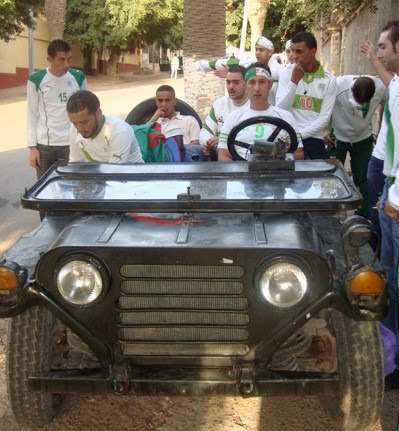
Patriotism in the Algerian capital, Algiers
I'm working in Algiers, the Algerian capital, on behalf of Culturissima, writing and researching a batch of cultural tours along Algeria's Mediterranean coast and deep down into the Sahara.

But the World Cup's just this moment started, and South Africa - the host country, of course, have just played their first match... so I've sent this off to a British football magazine for publication:

So much for African fraternity: the moment the referee blew the opening whistle for South Africa versus Mexico was the signal for the inhabitants of Algiers to desert their television sets and turn the streets of the capital into a Mediterranean Rio.

"Aren't you watching the game?"

"No, we want to have fun! One, Two, Three - Viva l'Algérie! Besides, it's sunny in North Africa but it's snowing in South Africa!"

He’s right: the television reception is poor – so much so that my neighbours devoted the whole of last night to hooking their ramshackle tv set directly to a huge satellite dish on the roof of a nearby tower block.

The reward for such initiative?

A spell behind bars - the dish sits on top of the local police headquarters.

Hopes are far from sky-high as Algeria gears up for Sunday’s opening clash between the Desert Foxes and Slovenia (Or is it Serbia? Croatia? Nobody seems to know).

"Une participation honorable, that’s what we’re after", says one local journalist: "But that’s the problem – that’s all we ever want: mediocrity. Give us our daily bread and fixed elections once every five years – that’s all we ever pray for".

Falah Benyoucef set out to disprove such cynicism by walking from Algiers to South Africa to watch Algeria’s first game, a journey of 8,000 miles.

It was only after trudging over the Atlas mountains, traversing the broad expanses of the Sahara desert and reaching Algeria’s southern border with Niger that Falah, now a national hero, inspected the visa in his passport: Maximum Stay in Niger – 24 Hours. Seven hundred miles in the space of a day was a feat too far even for Falah the Magnificent.

A few hundred wealthy Algerian supporters have made it to South Africa, flying from a special terminal that is normally reserved for pilgrims on their return from Mecca. On arriving the fans learned that "capitaine courage", Yazid Mansouri, has been dropped by manager Rabah Saadane, whose latest press conference ended with the hope that his team will make up for their individual weaknesses with collective desire.

This esprit de corps is very much alive in the western city of Oran – or that’s what the president of the region’s electricity board is promising: "We will have an équipe of highly trained engineers on duty during all Algeria’s matches. There is no reason for the public to panic".

Why the worry?

Well, many Oranais are still confused as to what happened to Zidane in the 2006 final. There was a power cut just before the forehead of Algeria’s most famous son made contact with Materazzi and many locals have still not seen the pictures of one of sport’s most iconic moments. It couldn't happen again, could it? Well, in the southern city of Ouargla the thermometer is now touching 46° in the shade, the power has gone off, the back-up generator has failed, there's no air-conditioning, no running water... but "One, Two, Three - Viva l'Algérie!"


Dr David Winter

Wednesday, June 9, 2010

Tartu


Am enjoying two or three days in the Baltic republics of Estonia, Latvia and Lithuania, where the countryside is studded with isolated manor houses, sturdy mediaeval castles and graceful Rococo churches.

We started in Tallinn, one of the gems of northern Europe, where the old town’s cobbled streets are ringed by mediaeval walls and ancient defensive towers. The fortified hill of Toompea, once the seat of the region’s bishops and nobility, is the setting for the Lutheran Toomkirik, built by the Danes in the early 13th century, and the 19th century Alexander Nevsky Cathedral, a souvenir of Russian authority.

But Tartu, founded in 1632 by the Swedish king Gustav Adolf, has probably been my favourite destination. The town is the beating intellectual heart of Estionia and, although sacked and pillaged throughout history, the historic core retains an air of peace and refinement, as befits the country’s oldest university town. Tartu also boasts its very own leaning tower, a marvellous neo-Classical cobbled square and, in St John’s Church, one of northern Europe’s most imposing brick Gothic monuments.

Wednesday, June 2, 2010

The principal objective is to not be ridiculous

Algerians like their flags large
This article, written by Culturissima's David Winter, was first published in the Racing and Football Outlook, June 2010

"The principal objective is to not be ridiculous"
Rabah Saadane, Algeria manager

The "Desert Foxes" are a team of largely French-born exiles - but never has an équipe of outsiders been loved with such pride and such passion. And, quaint though it may seem, only one thing matters to Algerian fans and players: being there. "What a privilege to be on the same pitch as England", says Foued Kadir, the Algerian midfielder who turns out for Valenciennes: "Lampard, Rooney, Gerrard – I watch them on tv and now I can’t believe I’ll be playing against them!"

There is little analysis in the Algerian press about the chances of Ziani, Bougherra and the boys in green but mention two subjects – the French coach and a coach in Cairo - and vooomph! the street cafés light up. According to a headline in Le Soir d’Algérie, "Domenech n’aime pas les Algériens".

The proof? He left Benzema and Nasri out of the French squad. And the Egyptians? During the combustible qualifier between the Rats and the Pharaohs last November, the Algerian team bus was stoned by a gang of locals. FIFA has just announced its "timides sanctions" against the Egyptian FA and the whole of Algiers is crying its favourite phrase: It’s a plot! It’s this fierce, often paranoid, closing of the ranks that could just leave "Mister Capello" looking faintly ridiculous on June 18.

Algeria at the World Cup

Win, lose or draw, there'll be war
This article - written by Culturissima's David Winter - was first published in When Saturday Comes May 30, 2010

What are the expectations for the team?
Low. It’s the taking part and the fact that Egypt won’t be there that counts. There is undiluted admiration for England, especially Wayne Rooney; the US are going to be a lot harder to beat than anyone thinks (largely due to their discipline and experience of World Cups) and no one remembers or much cares who the third team is. Even though there is not much hope, there is huge amounts of optimism. Over 40,000 national jerseys have been sold in France alone since qualification.

Is the coach popular?
Yes, he is. Rabah Saadane was even elected “Man of the Year” and, whatever happens, will largely remain so. For one, Algeria will never forget their defeat of Egypt (though they’re still awaiting with interest FIFA’s verdict on the stoning of the Algerian team bus in Cairo). Secondly, no matter how Algeria get knocked out, it will be the fault of the Egyptians, who apparently run FIFA.

Are there any players with unusual hobbies or business interests?
Many players are unknown as almost no one in the starting line-up lives in or was born in Algeria. Plus, only one player has ever and will ever count for Algeria: Zinedine Zidane.

Who are the best and worst interviewees?
Chadli Amri makes a good interviewee, especially when talking about the hogra of Algerians living in France (hogra means being excluded and held in contempt): “North Africans being molested in France or not given housing like the others? It happens all the time. Me, I’m not putting up with that.” The coach is good when it comes to slagging off Egypt. But Lionel Messi gets twice as many column inches as any Algerian. And Zidane only needs to fart to be in the papers.

Is the team likely to have any unusual goal celebrations?
All Algeria’s goal celebrations will be over-the-top. After qualifying, both at the stadium itself and on the victory drive from the airport back to the centre of Algiers, the players paraded with a mock version of the World Cup, as though they had already won it. Elsewhere, one might consider this arrogance; here it was innocent.

Have the team recorded a song for the World Cup?
No, but at the last count 28 CDs had been knocked out by various groups celebrating qualification. “One, two, three [sung in English in a very thick Algerian accent] – Viva l’Algérie!” earns rapturous applause everywhere.

What will the media coverage be like?
Wall to wall, both in French and Arabic, with all matches covered live – and French TV is streamed into most homes. People will celebrate and take to the streets for days even if they lose. Public debate about the team risks being seen as “déstabilisation de l’équipe nationale” unless you are a member of the 1986 World Cup squad, in which case it’s perfectly acceptable to start every sentence with: “In my day...”

Will there be many fans travelling to South Africa?
A couple of thousand very rich and very privileged Algerians are hoping to make it. As ever, though, they will have to surmount numerous bureaucratic hurdles. The government has decided that to obtain a new biometric passport, each citizen is obliged to list the names of the friends he had at primary school as well as their best friend during national service.

Friday, May 7, 2010

Algeria prepares for the World Cup

This article - written by Culturissima's David Winter - was first published in When Saturday Comes May 6, 2010 

To walk the streets of Algiers in early May is to be surrounded by thousands of locals clad in the green and white of the Desert Foxes. No surprise there – 40,000 national jerseys have been sold in France alone since the Fennecs' qualification against Egypt last November. What is surprising, though, is to find oneself supping a mint tea in a cafe heaving with bearded regulars sporting the three lions of England on their chests. At a rough guess there are twice as many people wearing England tops on Rue Didouche Mourade as there are on Oxford Street. Yet no one seems to know why.

It'll end in tears
It is such a cliche (and, far worse than that, a cliche invented by their former colonial masters across the Mediterranean) but, for the majority of Algerians gearing up for the World Cup, it really is the taking part that counts. Most Algerians couldn't name a single player in their team, with the possible exception of Karim Ziani, and all that they know about their manager is that one, he cried on national television and two, someone elected him "Man of The Year".

No, every football conversation across Algeria, from the Mediterranean to the Sahara, goes like this: "Ha, ha, Egypt didn't qualify! We're going to get trounced. But who cares? Let's party!" This is followed by: "Is Beckham in the England team?" (news takes time to filter through to North Africa). Les Verts are rarely interviewed on television, some of them have only ever been to Algeria once or twice, and, let's face it, only one player has ever and will ever count for Algeria: Zinedine Zidane.

A couple of thousand very rich and very privileged Algerians are hoping to make it to South Africa to support the Fennecs. As ever, though, they will have to surmount numerous bureaucratic hurdles – the government has decided that, to obtain one of the new biometric passports, each citizen is obliged to list the names of the friends he went to primary school with as well as the name of his best friend during National Service. As with the England tops, no one seems to know why.

Saturday, May 1, 2010

The Norwich school

Am just about to head off to Norwich, in East Anglia, to do a "recce" on the Norwich school of painters for a British client. The 19th century Norwich School, whose landscapes and seascapes recall the realism of Dutch 17th century painting, can justifiably claim to be the only regional art movement that England has ever known. If the father of the "Norwich Society of Artists" was John Crome, then its leading exponent was John Sell Cotman, widely regarded as one of the country’s most accomplished water-colourists.

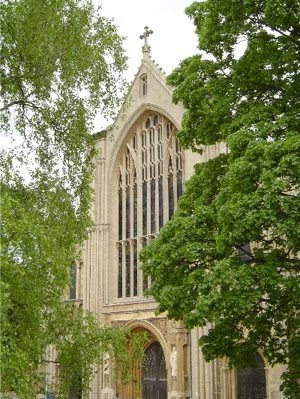
Norwich Cathedral
I'm going to look at some of the finest œuvres of the Norwich School and examine how the Norfolk countryside, its broads and rivers, inspired Crome and his fellow artists.  

Norwich Castle Museum and Art Gallery, the beneficiary of a lavish £12 million refit, hosts the most comprehensive collection of the work of the Norwich School. Alongside paintings by John Crome they have an unrivalled anthology of oils and water-colours by John Sell Cotman as well as landscapes by Robert Ladbrooke, James Stark and Crome's two sons, John Berney Crome and William Henry Crome.  Other local painters represented in the museum include Sir Alfred Munnings and Edward Seago.  

Henry Moore at Sainsbury's
So much for my background research - all that was new to me. What I did know, from previous visits to the region, is that Norwich’s fascination stretches far beyond its eponymous art school: the Sainsbury Centre celebrates the genius of Henry Moore, Giacometti, Bacon, Picasso and Modigliani, whilst Jacobean Blickling Hall evokes an altogether different era.  Reputedly home to the headless ghost of Anne Boleyn, Blickling is hung with family portraits by Gainsborough and boasts a splendid “Peter the Great Room”, which commemorates the service of the Earl of Buckinghamshire as ambassador to Russia.

Saturday, April 10, 2010

"This is paradise!"

Culturissima has the good fortune to be in Tuscany, partly lapping up the sun but also to prepare some copy on the Puccini Opera Festival, held every summer just a stone's throw from Lucca.

Giacomo Puccini was born in Lucca, “the most fly-in-amber little town in the world” according to Hilaire Belloc, in 1858. Our client - a British tour company - will be using mediaeval Lucca as the base for their visit to the 57th Puccini Opera Festival, held in the lakeside village of Torre del Lago, where Puccini composed, inter alia, Madame Butterfly, La Bohème and Tosca.

Even before the birth of Puccini, Lucca had enjoyed a vibrant musical history: the 18th century composers Francesco Geminiani and Luigi Boccherini were born within the famous city walls, and Puccini himself was descended from a family of musicians, with his father excelling as a composer and teacher.  Puccini was a choirboy in Lucca’s cathedral, played the organ in the Church of San Michele and studied at the Pacini School of Music.  Short of money, the young Puccini is thought to have played the piano in local taverns… and even in houses of ill repute.

"This is paradise!" exclaimed Puccini on his first visit to Torre del Lago, a quiet Tuscan hamlet sandwiched between the Apuan Alps and the Tyrrhenian Sea.  Puccini settled in Torre in 1891 and bought a country estate there at the turn of the century - the Villa Museo Puccini, which now houses his mausoleum. Close by is Torre’s great open-air theatre, inaugurated in 2008, and the idyllic setting for the annual opera festival in homage to Puccini. It is here, on the banks of Lake Massaciuccoli, that we our clients will attend Tosca, Turandot and La Bohème.

In Lucca itself the relaxed pace of life will allow our clients to enjoy the town’s musical, architectural and atmospheric richness to the full.  As well as following in the footsteps of Puccini we have gained special permission for them to enter the Palazzo Mansi with its fine frescoed ballroom and series of tapestries; the Villa Guinigi, a rare survivor among 14th century Gothic villas; and the tiny botanic garden just inside the city walls.

Sunday, April 4, 2010

The key to England

Culturissima has recently been commissioned to write and research a series of cultural and historical tours for English Heritage and one of their partners. It’s been a source of great joy to investigate parts of England that we haven’t travelled to in recent years – particularly the south-east.

The English Channel and the south-east coast of England have always played a pivotal role in the defence of our Great Britain.  Dover Castle, site of a Roman pharos that dates back to the 1st century AD, was long known as “the key to England”, and both Napoleon and Hitler earmarked these southern shores for sea-borne invasion.  And, of course, where they failed, William the Conqueror succeeded – the itinerary that we have devised for English Heritage will begin at the very spot where Harold met his end in 1066.

The Western Heights, rising to the west of Dover and surrounded by chalk meadows, form the largest Napoleonic defences ever constructed in Britain. The most substantial fortifications were erected in the early years of the 19th century as a bulwark against French attack, and the redoubt later sheltered a squad of commandos during World War II.

The castles at Rye, Bodiam, Walmer and Deal each have their own tale to tell, but it is Dover Castle, fortified by Henry II, that takes pride of place.  It was from the citadel’s secret tunnels, originally hewn to counter the threat of Napoleonic France, that Churchill and vice-admiral Ramsay masterminded the evacuation from Dunkirk.  By the end of World War II, this labyrinthine complex had been developed into a veritable underground city, housing not just a military headquarters but also a hospital and substantial barracks.

Wednesday, March 3, 2010

Sex tourism in Algeria

Central Algiers, where - just to
be clear - there is no sex tourism
I've just come back from another stay in Algiers, where I was invited, on behalf of Culturissima, to attend a travel show in the heart of the Algerian capital at the famous Hotel St Georges - famous because it's Algiers' oldest hotel, and it was here that Roosevelt set up his headquarters during World War II. 

As the only foreigner in attendance, I was - for once in my life - in great demand and enjoyed, momentarily at least, playing "hard to get".  A clutch of Algerian travel agencies was keen to suggest various forms of partnership with "the sir from England" but the greatest interest was shown by the Algerian media. Being interviewed - especially in a foreign language - is great fun at first... it soon becomes pretty wearing, though, answering the same questions: Why are you in Algeria? What do you think the future of tourism is in Algeria? Are the beaches nicer here than in Tunisia?


By the fifth interview, with the television lights bouncing off my bald head, I'd had enough - except that, a rarity in Algeria, there was a young woman waiting to interview me. Fresh out of journalism school, she began to ask me the same set of questions: What is your name? Where are you from? Why are you here?  

"Well, I'm here on behalf of a British tour company, looking to see what opportunities there might be to develop our market here".
 

"What is your market?" 

"Well, normally we operate in the Far East, but we've exploited all that region's opportunities for sexual tourism so now we're hoping to develop the same market in Algeria" - I said this with a straight face but was sure that she'd twig that I was pulling her leg. 

"And what age group will your tours be aimed at?"  

"Middle-aged men, largely".  

"About your age?"  

"That's right" - cheeky thing, I thought... but she still hadn't grasped that I was stringing her along.   
"And how big will they be?"  

"I beg your pardon?"
 

 "How big will the groups be?" It was at this moment that her minder - a middle aged man like myself but with a sense of humour - gently whispered in her ear that I was taking the micky.  

Tuesday, February 2, 2010

Virtually unknown in the English-speaking world

Less than three hours from London, yet virtually unknown in the English-speaking world, Algiers is one of the Mediterranean's most mesmerising cities, a captivating mélange of faded French grandeur and neo-Moorish folly crowned by a legendary casbah. 
The esplanade, central Algiers
Were "Alger La Blanche" situated on the northern coast of the Mediterranean, this dazzling euphony of blue and white would be one of Europe's most sought after destinations.

A lived-in, weather-warmed city, the Algerian capital is home to some of the most exuberant, playful art deco architecture anywhere in the world. Yet the boulevards of this Mediterranean Paris are also lined with mosques and minarets, notably the 17th century Fishermen's Mosque, as well as neo-Moorish delights such as the Grande Poste.

Central Algiers: imagine a lick of paint!
The casbah - "a masterpiece of architecture and town planning" according to Le Corbusier - remains one of the world's most mythical labyrinths, its huddled houses tumbling down the hill-side before seemingly spilling over into the sea.
The interior of one of Algiers' palaces