Friday, February 27, 2009

Alger La Blanche

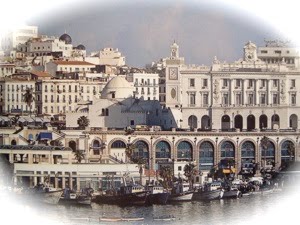
The port of Algiers
Culturissima has visited Algeria twice in 2009 to carry out some research on behalf of a British cultural tour operator and can confirm that the Roman sites of Timgad, Tipasa and Tiddis are as beautiful and as captivating as ever… and that the capital Algiers remains one of the Mediterranean's most alluring cities, its superb French architecture an entirely unexpected delight for most European visitors (who are still avoiding Algeria en masse!). 
Caryatids in central Algiers

I was fortunate enough to take a whole-day excursion through some of Algeria’s most breath-taking scenery to the oasis town of Biskra, situated on the northern fringes of the Sahara. My journey south took me through the Aurès Mountains and the gorge of Tighanimine to Biskra, gateway to the desert, where a local family invited me to eat in their private palm grove. En route I visited the abandoned canyon village of Rhoufi and passed through El Kantara, once known as Calceus Herculis (Hercules' Boot).

I’m now back on the coast, at the Hotel Safir, once the favoured haunt of Charlie Chaplin, of all people, overlooking the Bay of Algiers. It’s comforting to be back here - it’s familiar territory to me - but, as I’ve said elsewhere, everyone should have the chance to step foot in the Sahara at least once during their lives.
The mark of Baron Haussmann is alive and well in Algiers

The Bay of Algiers
I lived in Algeria for two years as a child and it is a country I love deeply: the historical sites are superb - Tiddis, with its remote hill-top setting, is perhaps my favourite - and the Algerians I have met have shown nothing but warmth, friendship, respect and hospitality. If you've enjoyed travelling in the Maghreb or Libya, then you are likely to find Algeria an even more rewarding (and even more adventurous!) destination.

Over the coming weeks I hope I’ll be able to write a little more about some of the towns I’ve visited and the people I met.

Monday, February 2, 2009

I am the great lion of the day

Part of Culturissma's monthly schedule is to brief our clients on up-coming art exhibitions so that they can steal a march on their rivals. We've just got wind of a new offering at London's Tate BritainTurner and the Masters, which will be the first ever exhibition to examine the influence of the Old Masters on J M W Turner.  As well as displaying some of Turner's most scintillating canvases, Turner and the Masters will showcase around 100 works by Canaletto, Poussin, Rubens, Rembrandt and Constable.

Born in 1775, Turner - the London-born son of a barber - was always confident of his abilities, once proclaiming: "I am the real lion. I am the great lion of the day". The Tate exhibition will investigate the complexity of Turner's obsession with the Old Masters as he strove first to imitate, then rival and finally surpass the style of Rubens, Rembrandt and Claude Lorrain.  Acts of homage will hang alongside sophisticated forms of art criticism in an exhibition that is likely to re-establish Turner's reputation as the greatest painter of landscape in the European tradition.

Friday, January 2, 2009

Pierre-Auguste Renoir in Paris

One of Renoir's former homes in Montmartre,
with the Sacré Coeur in the background
I have the good fortune to live among the cobbled streets of Montmartre, within rioting distance of the Sacré Coeur and just a fifteen minute bicycle ride - all downhill - to the Louvre and the Musée d’Orsay.    My apartment overlooks a narrow, winding road that was painted by, amongst others, Cézanne, Picasso, van Gogh and the unfortunate Utrillo.

Lodged on the corner of our narrow lane is the pink façade of the famous Lapin Agile bistro, where the likes of Picasso, Utrillo, Derain, Braque and Modigliani once held court. It’s in this bar, formerly known as the Cabaret des Assassins, that a donkey once painted a canvas - Sunset on the Adriatic Sea - that ended up being hung in the prestigious annual Salon des Independents! It’s a lovely spot, too, to open a bottle of wine in the early evening in summer, as the sun comes streaming down the hill.

Picasso is never far from our thoughts here in Montmartre: to reach my local bar, I meander down the southern slopes of the hill past the Laundry Boat - Le Bateau Lavoir - where he once lived and painted.   There's another, more personal, connection, too: I bought my apartment from a chap - the make-up artist for President Mitterand's wife, as it happens - whose new next door neighbour, just five minutes away, is Picasso's former lover and the mother of his children, Claude and Paloma.  Her name is Francoise Gilot and, though Picasso died in 1973, Mme Gilot is still very much alive and kicking - and painting, too, as she is a celebrated painter in her own right.

Anyway, at the moment Culturissima is busy setting up two art tours for a major British client, a company that runs cultural and historic programmes across the world. The first tour is called "In The Footsteps of The Impressionists" and the second, "Renoir in Paris".  

The latter has been timed to coincide with a Renoir retrospective, Les Dernières Années, that will be held at the Grand Palais, just off the Champs Elysées, at the end of 2009.  This exhibition, details of which have yet to be released to the general public, will concentrate on the final period of Renoir's life when his nudes, later to influence Bonnard, Matisse and Picasso, drew their inspiration from the Old Masters.

Renoir's house in autumn, with
the Montmartre vineyard in the foreground
Although born in Limoges, Renoir se considérait comme un Parisien, according to his son. He lived part of his childhood alongside the former Tuileries Palace - and even used to disturb the Queen of France with his games! - before eventually settling in bucolic Montmartre, a world away from the new Paris of the demolition man, Baron Haussmann. One of Renoir’s first houses was in rue Cortot, now a museum and it was on the hill of Montmartre, with its vineyard, windmills and sweet-smelling gardens, that Renoir painted and here one can still see the Moulin de la Galette, the windmill immortalised in the eponymous painting on display at the Musée d'Orsay.  

Tuesday, November 11, 2008

The Old Women and the Young Women

Culturissima has just returned from two days in northern France on behalf of one of our British clients, a travel agency based just outside Cambridge that wants to put together a tour of Lille and its environs.

What are we going to report back?

First, that Goya’s twin canvases The Old Women and The Young Women are enough in themselves to attract the art-lover to northern France.  Yet Lille, where Flemish tradition meets French culture, and Valenciennes, the birthplace of Antoine Watteau, have many other exquisite treasures on display.

Lille’s Palais des Beaux Arts hosts the most valuable gathering of art in France outside Paris - not just the magnificent Goyas but also an outstanding collection of Old Master pictures and sculpture with work by Donatello, Rubens, van Dyck and Jordaens. The galleries also house an impressive selection of French 18th and 19th century gems with major œuvres by Jacques-Louis David. A short distance away lies the 13th century Hospice Comtesse, hung with 15th to 18th century paintings together with tapestries by Guillaume Werniers.

Valenciennes’ Musée des Beaux Arts pays ample tribute to the creative talent of the town’s two most famous sons, Watteau and Jean-Baptiste Carpeaux. The museum is also the setting for a notable group of Flemish 17th century paintings, in particular Rubens triptych of St Etienne and Descent from the Cross.

The focal point of our afternoon in the cathedral town of Tournai was the Musée des Beaux Arts, designed by the Belgian art nouveau architect Victor Horta. The museum’s holdings stretch from the early Flemish tradition to Monet and Seurat.   And our final day was spent re-visiting the Museum of Modern Art in Villeneuve d’Ascq, set in a verdant sculpture park and endowed with prized work by Picasso, Braque, Modigliani and Miro.

Friday, August 8, 2008

Having fun in Paris and London

Puppy love in a Paris bar
A propos nothing, they're just not aspirational are they, them Frenchies? Not in the same way as, say, your typical Englishman - or woman - is. 

Or maybe your "average" French madame or monsieur is aspirational in a way that my Anglo-Saxon mind can't quite fathom?

I've just come back to Paris from a couple of days in London, you see, and one of the things that struck me the most was the way Jo English wears the latest fashions, drives a good car and owns his own house. Or if he doesn't, he - or she - wants to.

Most of all, though, the Londoners I bumped into were intent on having a good evening out with their mates.  At six o'clock the streets are choked with people mobiling or texting one another: "What you up to tonight? Yeah, me and Dave and Bob are meeting the girls at that new bar and then we're off down..."

Okay, so I spent most of my time on Clapham High Street, but even on a Wednesday evening, there was a buzz: the guys and the girls are all dressed up, they're showing off their tans, talking loud, drinking hard. In six years here in Paris, I've never witnessed that kind of atmosphere, where groups of blokes and birds are out "on the pull" or "on the razz". Londoners invest so much energy (and money, no doubt) in letting their hair down - there was no trouble, no aggression, no-one kopped off with anyone... but the drive was there. 

In an equivalent bar in Paris, the music wouldn't be so loud, the glasses of beer wouldn't be so large, the skirts wouldn't be so short - and the girls wouldn't even have bothered to wash their hair for such a run of the mill night out!  What's more, your typical Parisian wouldn't have just come back from three weeks in Goa or whatever else is hip at the moment. In fact, he would still be on holiday - it is August, after all - and he would have taken his "vacances" in the family property in Normandy or in his parents' home down on the Mediterranean coast.

To me, London's a bit startling, a bit "speed" - but you can see why young people are attracted to the British capital because it's dynamic, it's animated, people are going after what they want, sometimes excessively, sometimes admirably.

And then there's the food - even that's aspirational in London! In a run down pub, a guy was ordering from the menu, "... and I'll have that with the fresh salad with the lightly-roasted Mediterranean vegetables". Uh, with what? Or in the supermarket you buy pea and coriander soup with a hint of something-or-other. 

Most of all, if you're still with me, the English aspire to be anything other than English. 

Go on holiday in England? Pull the other one, mate. Eat typically English food? Go to a traditional English pub (unless, of course, it was in the country)? You must be joking! The whole of London seems bent on being European - or what the Brits consider to be European, because the reality is that none of these bars, none of this food (the French eat "steak frites", right, and couscous, none of this ponced-up English fare), none of these fashions exists outside England! 

And, of course, your Frenchman eats French food and doesn't go on holiday abroad 'cos French food is the best and the French landscape the most beautiful.
Sunday, August 19, 2007

Culturissima's First Visit to Dublin

Just got back from Dublin, which must be one of Europe's most colourful destinations, an intoxicating city where the gift of the gab and letting your hair down are as highly valued as the capital's myriad cultural delights. 

The spirit of Oscar Wilde, James Joyce and Samuel Beckett is never far away, and there are castles, museums and galleries to suit all tastes. A forward-looking city, Dublin somehow manages to combine urban sophistication with the charm of a traditional Irish welcome.