Friday, May 7, 2010

Algeria prepares for the World Cup

This article - written by Culturissima's David Winter - was first published in When Saturday Comes May 6, 2010 

To walk the streets of Algiers in early May is to be surrounded by thousands of locals clad in the green and white of the Desert Foxes. No surprise there – 40,000 national jerseys have been sold in France alone since the Fennecs' qualification against Egypt last November. What is surprising, though, is to find oneself supping a mint tea in a cafe heaving with bearded regulars sporting the three lions of England on their chests. At a rough guess there are twice as many people wearing England tops on Rue Didouche Mourade as there are on Oxford Street. Yet no one seems to know why.

It'll end in tears
It is such a cliche (and, far worse than that, a cliche invented by their former colonial masters across the Mediterranean) but, for the majority of Algerians gearing up for the World Cup, it really is the taking part that counts. Most Algerians couldn't name a single player in their team, with the possible exception of Karim Ziani, and all that they know about their manager is that one, he cried on national television and two, someone elected him "Man of The Year".

No, every football conversation across Algeria, from the Mediterranean to the Sahara, goes like this: "Ha, ha, Egypt didn't qualify! We're going to get trounced. But who cares? Let's party!" This is followed by: "Is Beckham in the England team?" (news takes time to filter through to North Africa). Les Verts are rarely interviewed on television, some of them have only ever been to Algeria once or twice, and, let's face it, only one player has ever and will ever count for Algeria: Zinedine Zidane.

A couple of thousand very rich and very privileged Algerians are hoping to make it to South Africa to support the Fennecs. As ever, though, they will have to surmount numerous bureaucratic hurdles – the government has decided that, to obtain one of the new biometric passports, each citizen is obliged to list the names of the friends he went to primary school with as well as the name of his best friend during National Service. As with the England tops, no one seems to know why.

Saturday, May 1, 2010

The Norwich school

Am just about to head off to Norwich, in East Anglia, to do a "recce" on the Norwich school of painters for a British client. The 19th century Norwich School, whose landscapes and seascapes recall the realism of Dutch 17th century painting, can justifiably claim to be the only regional art movement that England has ever known. If the father of the "Norwich Society of Artists" was John Crome, then its leading exponent was John Sell Cotman, widely regarded as one of the country’s most accomplished water-colourists.

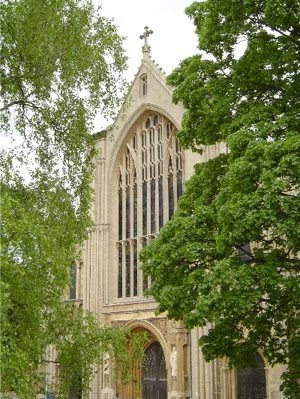
Norwich Cathedral
I'm going to look at some of the finest œuvres of the Norwich School and examine how the Norfolk countryside, its broads and rivers, inspired Crome and his fellow artists.  

Norwich Castle Museum and Art Gallery, the beneficiary of a lavish £12 million refit, hosts the most comprehensive collection of the work of the Norwich School. Alongside paintings by John Crome they have an unrivalled anthology of oils and water-colours by John Sell Cotman as well as landscapes by Robert Ladbrooke, James Stark and Crome's two sons, John Berney Crome and William Henry Crome.  Other local painters represented in the museum include Sir Alfred Munnings and Edward Seago.  

Henry Moore at Sainsbury's
So much for my background research - all that was new to me. What I did know, from previous visits to the region, is that Norwich’s fascination stretches far beyond its eponymous art school: the Sainsbury Centre celebrates the genius of Henry Moore, Giacometti, Bacon, Picasso and Modigliani, whilst Jacobean Blickling Hall evokes an altogether different era.  Reputedly home to the headless ghost of Anne Boleyn, Blickling is hung with family portraits by Gainsborough and boasts a splendid “Peter the Great Room”, which commemorates the service of the Earl of Buckinghamshire as ambassador to Russia.

Saturday, April 10, 2010

"This is paradise!"

Culturissima has the good fortune to be in Tuscany, partly lapping up the sun but also to prepare some copy on the Puccini Opera Festival, held every summer just a stone's throw from Lucca.

Giacomo Puccini was born in Lucca, “the most fly-in-amber little town in the world” according to Hilaire Belloc, in 1858. Our client - a British tour company - will be using mediaeval Lucca as the base for their visit to the 57th Puccini Opera Festival, held in the lakeside village of Torre del Lago, where Puccini composed, inter alia, Madame Butterfly, La Bohème and Tosca.

Even before the birth of Puccini, Lucca had enjoyed a vibrant musical history: the 18th century composers Francesco Geminiani and Luigi Boccherini were born within the famous city walls, and Puccini himself was descended from a family of musicians, with his father excelling as a composer and teacher.  Puccini was a choirboy in Lucca’s cathedral, played the organ in the Church of San Michele and studied at the Pacini School of Music.  Short of money, the young Puccini is thought to have played the piano in local taverns… and even in houses of ill repute.

"This is paradise!" exclaimed Puccini on his first visit to Torre del Lago, a quiet Tuscan hamlet sandwiched between the Apuan Alps and the Tyrrhenian Sea.  Puccini settled in Torre in 1891 and bought a country estate there at the turn of the century - the Villa Museo Puccini, which now houses his mausoleum. Close by is Torre’s great open-air theatre, inaugurated in 2008, and the idyllic setting for the annual opera festival in homage to Puccini. It is here, on the banks of Lake Massaciuccoli, that we our clients will attend Tosca, Turandot and La Bohème.

In Lucca itself the relaxed pace of life will allow our clients to enjoy the town’s musical, architectural and atmospheric richness to the full.  As well as following in the footsteps of Puccini we have gained special permission for them to enter the Palazzo Mansi with its fine frescoed ballroom and series of tapestries; the Villa Guinigi, a rare survivor among 14th century Gothic villas; and the tiny botanic garden just inside the city walls.

Sunday, April 4, 2010

The key to England

Culturissima has recently been commissioned to write and research a series of cultural and historical tours for English Heritage and one of their partners. It’s been a source of great joy to investigate parts of England that we haven’t travelled to in recent years – particularly the south-east.

The English Channel and the south-east coast of England have always played a pivotal role in the defence of our Great Britain.  Dover Castle, site of a Roman pharos that dates back to the 1st century AD, was long known as “the key to England”, and both Napoleon and Hitler earmarked these southern shores for sea-borne invasion.  And, of course, where they failed, William the Conqueror succeeded – the itinerary that we have devised for English Heritage will begin at the very spot where Harold met his end in 1066.

The Western Heights, rising to the west of Dover and surrounded by chalk meadows, form the largest Napoleonic defences ever constructed in Britain. The most substantial fortifications were erected in the early years of the 19th century as a bulwark against French attack, and the redoubt later sheltered a squad of commandos during World War II.

The castles at Rye, Bodiam, Walmer and Deal each have their own tale to tell, but it is Dover Castle, fortified by Henry II, that takes pride of place.  It was from the citadel’s secret tunnels, originally hewn to counter the threat of Napoleonic France, that Churchill and vice-admiral Ramsay masterminded the evacuation from Dunkirk.  By the end of World War II, this labyrinthine complex had been developed into a veritable underground city, housing not just a military headquarters but also a hospital and substantial barracks.

Wednesday, March 3, 2010

Sex tourism in Algeria

Central Algiers, where - just to
be clear - there is no sex tourism
I've just come back from another stay in Algiers, where I was invited, on behalf of Culturissima, to attend a travel show in the heart of the Algerian capital at the famous Hotel St Georges - famous because it's Algiers' oldest hotel, and it was here that Roosevelt set up his headquarters during World War II. 

As the only foreigner in attendance, I was - for once in my life - in great demand and enjoyed, momentarily at least, playing "hard to get".  A clutch of Algerian travel agencies was keen to suggest various forms of partnership with "the sir from England" but the greatest interest was shown by the Algerian media. Being interviewed - especially in a foreign language - is great fun at first... it soon becomes pretty wearing, though, answering the same questions: Why are you in Algeria? What do you think the future of tourism is in Algeria? Are the beaches nicer here than in Tunisia?


By the fifth interview, with the television lights bouncing off my bald head, I'd had enough - except that, a rarity in Algeria, there was a young woman waiting to interview me. Fresh out of journalism school, she began to ask me the same set of questions: What is your name? Where are you from? Why are you here?  

"Well, I'm here on behalf of a British tour company, looking to see what opportunities there might be to develop our market here".
 

"What is your market?" 

"Well, normally we operate in the Far East, but we've exploited all that region's opportunities for sexual tourism so now we're hoping to develop the same market in Algeria" - I said this with a straight face but was sure that she'd twig that I was pulling her leg. 

"And what age group will your tours be aimed at?"  

"Middle-aged men, largely".  

"About your age?"  

"That's right" - cheeky thing, I thought... but she still hadn't grasped that I was stringing her along.   
"And how big will they be?"  

"I beg your pardon?"
 

 "How big will the groups be?" It was at this moment that her minder - a middle aged man like myself but with a sense of humour - gently whispered in her ear that I was taking the micky.  

Tuesday, February 2, 2010

Virtually unknown in the English-speaking world

Less than three hours from London, yet virtually unknown in the English-speaking world, Algiers is one of the Mediterranean's most mesmerising cities, a captivating mélange of faded French grandeur and neo-Moorish folly crowned by a legendary casbah. 
The esplanade, central Algiers
Were "Alger La Blanche" situated on the northern coast of the Mediterranean, this dazzling euphony of blue and white would be one of Europe's most sought after destinations.

A lived-in, weather-warmed city, the Algerian capital is home to some of the most exuberant, playful art deco architecture anywhere in the world. Yet the boulevards of this Mediterranean Paris are also lined with mosques and minarets, notably the 17th century Fishermen's Mosque, as well as neo-Moorish delights such as the Grande Poste.

Central Algiers: imagine a lick of paint!
The casbah - "a masterpiece of architecture and town planning" according to Le Corbusier - remains one of the world's most mythical labyrinths, its huddled houses tumbling down the hill-side before seemingly spilling over into the sea.
The interior of one of Algiers' palaces


Monday, January 25, 2010

Dead: the last Jew

The "last Jew in Oran", once home to
 a thriving Jewish community, has passed away
I am on a plane between Algiers and Oran as I write this (I'll post it on arrival, insh'Allah) and have just come across this article (attached - taken with my camera 'phone, I'm afraid) in Le Soir d'Algérie newspaper. I don't have time for a full translation, unfortunately, but basically it's recounting how the last Jew in the Mediterranean city of Oran (to the west of Algiers, the capital) has just passed away.
Correction
I've been told the article appeared in Le Figaro and not its Algerian counterpart.

Wednesday, December 30, 2009

Europe's "Cities on the Edge" fight back

On January 1, two years after Liverpool and three years before Marseilles, Istanbul becomes European Capital of Culture for 2010.  For five years these great ports, together with Bremen, Gdansk and Naples, have been trying to form a network of European cities "of ill repute". 

Marseilles: a "City on the Edge"?
They are the cities that love to be hated: rebellious and out of the ordinary, founded as ports but largely insular in outlook, they are cities of football and plunder.  But they are fighting back, turning to culture to help them on the road to recovery.  In 2010 Istanbul is European Capital of Culture, two years after Liverpool and three years before Marseilles. Almost by chance these three multi-cultural cities, together with Naples, Bremen and Gdansk, have embarked on an adventure known as "Cities on the Edge", a support network of the “most hated cities in their own countries".

Monday, December 28, 2009

Crocodiles and jellyfish in the Sahara

A guelta in the Algerian Sahara
Algeria isn't the easiest country to do business in - in fact, it's the most difficult destination that we operate in - but it is the most diverse and above all, the most beautiful and the most unspoilt.

Footprints in the desert
Algeria's mountainous Tassili region, bordering Libya to the east and Niger to the south, is distinguished by its towering dunes of sand, its sheer-sided canyons and its beguiling "forests of rock". The Tassili - "plateau of the rivers" in Arabic - is an open-air treasure-trove of more than 15,000 rock carvings and cave paintings that depict pre-historic crocodiles and cattle, giraffes and jellyfish.

Starting from the white-washed oasis town of Djanet, we recently navigated the Tassili's intoxicating landscape of palm-groves, wadis and dunes by camel, on foot and by jeep. Our tour (and, remember, Culturissima wasn't in the Sahara here on holiday - this was business!) - spent three nights under the Saharan stars as we tracked down the region's gueltas, the desert water-holes that sustain the Tassili's Tuareg nomads.

On the horizon
We also sought out the tarout, the endemic Saharan cypress trees that are over 2,000 years old... but we didn't encounter one of the Sahara's most extra-ordinary living creatures - crocodylus niloticus, an indigenous dwarf crocodile! Maybe next time!

Thursday, December 17, 2009

F N Born 12 May 1820, Died 13 August 1910

At the moment I am putting together a collection of historical and cultural tours, many of which have a strong biographical element, for a British heritage organisation.

Next year (2010) sees the 100th anniversary of the death of a veritable heroine, Florence Nightingale. I've begun researching Florence’s life, and one of the first things that has struck me is Nightingale's strangely silent grave, where the memorial for one of the 19th century’s most lauded figures is no more eloquent than:

F.N. Born 12 May 1820, Died 13 August 1910.

"A wild swan" to her mother, "the lady with the lamp" to the readers of the contemporaneous Illustrated London News, the founder of modern nursing was many things: a tireless campaigner, an accomplished mathematician and statistician, and, I’ve just discovered, even the author of a novella, Cassandra.

Following in Nightingale’s footsteps has led me to stumble on one of London’s most unexpected curiosities. I already knew about the newly-extended Florence Nightingale Museum, located on the site of the pioneering nursing school that she founded at St Thomas’ Hospital in 1860. But the remains of the original St Thomas’ - named after Thomas Becket and Thomas the Apostle - lie eastwards around a bend in the Thames. Tucked away at the top of a rickety spiral staircase in the attic of St Thomas’s Church is England’s oldest surviving operating theatre, constructed in 1822, and, believe me, it doesn’t require much imagination to hear the screams of those pre-anesthetic days! Equally fascinating is the lonely garret used by the hospital’s apothecary to store and cure the medicinal herbs used during the operations.