As well as unearthing the story of Florence Nightingale, my current work for Culturissima and English Heritage has been introducing me to a handful of historical figures whom I was previously only dimly aware of.
One of my favourite discoveries is General Augustus Pitt Rivers (1827-1900), a soldier and archaeologist extra-ordinaire. Widely considered the father of modern British archaeology, the General was also a committed philanthropist: from the early 1890s onwards he set about designing Larmer Tree Gardens,"an extraordinary example of Victorian extravagance and vision" set in the heart of Dorset, south-west England.
Pitt Rivers created Larmer for the delectation and delight of the general public, and, as well as admiring the parkland, pagodas and free-flying parrots, it’s also possible to visit some of the ancient burial sites and villages unearthed by Pitt Rivers. A modern equivalent of Pitt Rivers is Martin Green, one of Dorset’s foremost field archaeologists, whose private museum at Down Farm houses the archaeological remains that Green has excavated on his land over the past 40 years.
Sir Robert Walpole (1676-1745) is another of the colourful characters who has been populating my working life (and dreams!) over the past couple of weeks. Walploe is a British politician who dominated parliament for over two decades; in fact, he’s generally regarded as Britain's first prime minister.
Born at Houghton Hall in Norfolk, one of England’s grandest country houses, and later educated at Eton and Cambridge, Walpole was the first prime minister to live and work at 10 Downing Street. Life wasn’t always so easy for Sir Bob, though: ridiculed as Sir Blustering by his enemies, he sailed closed to corruption on more than one occasion and even spent six months marooned in the Tower of London.
My favourite encounter of the last few weeks, though, hasn’t been with an archaeologist or politician.
Hairy, club-carrying and wood-dwelling, the wild man or "woodwose" is a familiar figure in mediaeval art and literature. Part-man, part-beast, he - and sometimes even she - can still be seen going about his daily business, whether it’s hunting lions with a Herculean club or throwing a pagan stare over a congregation of Christians. The wild man is carved into the very fabric of Norfolk and Suffolk: the region’s early churches and historic houses, even its heraldic coat of arms, bear fertile witness to the potency of the woodwose. East Anglia is still alive, too, with tales of beasts and monsters - including the 12th century wild man of Orford:
Men fishing in the sea caught in their nets a wild man. He was naked and was like a man in all his members, covered with hair and with a long shaggy beard. Brought into church, he showed no signs of reverence or belief.
Tuesday, August 18, 2009

Ce n'est pas possible!
The Algerian Embassy in Paris - I always venture there with mixed feelings: happy at the thought of applying for a visa to go back to Algeria... but fairly sure that something will go wrong before that visa is finally pasted into the pages of my passport.
This is the third Algerian visa I've applied for in the past few months, so I've become something of an old hand now at gathering all the required paper-work together (in multiples of at least three). And I'm pretty familiar with all the tricks of Algerian bureaucracy: you can only pay for the visa in hard cash, you have to write in block capitals in a black pen, you have to declare undying love for Algérie (and add for good measure what rotters the French were and the Americans are).
Anyway, I turned up at the embassy, just a short hop from the Arc de Triomphe here in Paris, armed with all the usual parephenalia. The visa office opens at nine-thirty in theory and ten thirty in practice. Having patiently waited my turn, I prefer to hand over a single document at a time, so I can triumph each of the clerk's triumphal looks - "Ah, but you don't have Form B52, Section A" - with my own triumphal: "Bah, si, si, Monsieur: le voilà!" This dance goes on for about ten minutes until the official asks for a document with my proof of residence on it.
It's at this point that I always say: "No, Monsieur, you are mistaken: I checked the documents on your web-site very carefully and nowhere does it say that one needs proof of residence".
"No proof of residence, no visa".
"Ce n'est pas possible! Why doesn't it say that on the web-site or in the information pack, then?
"Don't ask me. You're not French so you need proof of residence".
"I'm European, so I don't need one".
"Next!"
I then draw the proof of residence letter out of my pocket and give it to the official. He makes me wait ten minutes, says come back tomorrow at ten and collect your visa, I come back at ten to collect the visa, he says come back at ten tomorrow... and eventually I get it.
Except not this time. Because this time, unlike only a couple of months ago, the gatekeeper won't accept a letter from my bank as proof of where I live. "You could have a bank account at one address and live at another". "Uh, why would I do that then? I'm a law-abiding citizen", I say with a smile.
"Next!"
"Oh, comme on, you were happy with exactly the same document six weeks ago".
"That was a favour".
So what do I need? I need a letter from the French equivalent of British Telecom or British Gas. "But", I point out, "I am renting my flat, it's in my girlfriend's name, so I don't have anything like that".
His response? The owner of the flat has to write a letter, go to the town hall, get it stamped, then I have to bring it in to the embassy, he'll get it stamped... et voilà, I can start to apply for the visa all over again.
One small problem, I say: the owner of the flat lives in America. "Okay, he has to..." well, all of the above, but in addition he has to get the document translated into French first... yeah, right, in the middle of the American mid-west. I decided it would be easier to get the visa from the British Embassy in London.
When I told this story to an Algerian friend, she pointed out: it costs an Algerian living in Algeria three times as much money to get a visa to come to London; they have to queue for three times as long; and then the embassy never writes to them to tell them whether they've been successful or not... so they have to go through all the queuing a second or a third time to see whether they can come to sunny old England.
This is the third Algerian visa I've applied for in the past few months, so I've become something of an old hand now at gathering all the required paper-work together (in multiples of at least three). And I'm pretty familiar with all the tricks of Algerian bureaucracy: you can only pay for the visa in hard cash, you have to write in block capitals in a black pen, you have to declare undying love for Algérie (and add for good measure what rotters the French were and the Americans are).
Anyway, I turned up at the embassy, just a short hop from the Arc de Triomphe here in Paris, armed with all the usual parephenalia. The visa office opens at nine-thirty in theory and ten thirty in practice. Having patiently waited my turn, I prefer to hand over a single document at a time, so I can triumph each of the clerk's triumphal looks - "Ah, but you don't have Form B52, Section A" - with my own triumphal: "Bah, si, si, Monsieur: le voilà!" This dance goes on for about ten minutes until the official asks for a document with my proof of residence on it.
It's at this point that I always say: "No, Monsieur, you are mistaken: I checked the documents on your web-site very carefully and nowhere does it say that one needs proof of residence".
"No proof of residence, no visa".
"Ce n'est pas possible! Why doesn't it say that on the web-site or in the information pack, then?
"Don't ask me. You're not French so you need proof of residence".
"I'm European, so I don't need one".
"Next!"
I then draw the proof of residence letter out of my pocket and give it to the official. He makes me wait ten minutes, says come back tomorrow at ten and collect your visa, I come back at ten to collect the visa, he says come back at ten tomorrow... and eventually I get it.
Except not this time. Because this time, unlike only a couple of months ago, the gatekeeper won't accept a letter from my bank as proof of where I live. "You could have a bank account at one address and live at another". "Uh, why would I do that then? I'm a law-abiding citizen", I say with a smile.
"Next!"
"Oh, comme on, you were happy with exactly the same document six weeks ago".
"That was a favour".
So what do I need? I need a letter from the French equivalent of British Telecom or British Gas. "But", I point out, "I am renting my flat, it's in my girlfriend's name, so I don't have anything like that".
His response? The owner of the flat has to write a letter, go to the town hall, get it stamped, then I have to bring it in to the embassy, he'll get it stamped... et voilà, I can start to apply for the visa all over again.
One small problem, I say: the owner of the flat lives in America. "Okay, he has to..." well, all of the above, but in addition he has to get the document translated into French first... yeah, right, in the middle of the American mid-west. I decided it would be easier to get the visa from the British Embassy in London.
When I told this story to an Algerian friend, she pointed out: it costs an Algerian living in Algeria three times as much money to get a visa to come to London; they have to queue for three times as long; and then the embassy never writes to them to tell them whether they've been successful or not... so they have to go through all the queuing a second or a third time to see whether they can come to sunny old England.
Thursday, July 30, 2009
Fat ladies, a beheading and the Clapham Junction mystery
The first time I set foot on Malta, seven years ago now, I was here on the trail of a gruesome beheading. Faith, Hope and Charity was the theme of my next visit, whilst more recently I've made the trip across the Mediterranean in an attempt sniff out the truth behind Clapham Junction.
Every time that I touch down at Valletta airport though, I've only got one thing on my mind: how to avoid being seduced - yet again - by the honey-coloured island's elephantine-wasted, dainty-ankled fat ladies.
No one does tack like a Maltese Catholic: think Lourdes made-over by a nouveau riche east European gay - that will give you some idea of the cacophony of colour and the überglitz that boggles the mind when walks across the threshold of even the smallest Baroque church (as in the two photos).
To be continued.
 |
| The Grand Harbour, Valletta, Malta |
Every time that I touch down at Valletta airport though, I've only got one thing on my mind: how to avoid being seduced - yet again - by the honey-coloured island's elephantine-wasted, dainty-ankled fat ladies.
No one does tack like a Maltese Catholic: think Lourdes made-over by a nouveau riche east European gay - that will give you some idea of the cacophony of colour and the überglitz that boggles the mind when walks across the threshold of even the smallest Baroque church (as in the two photos).
To be continued.
Monday, June 22, 2009
Were the first Europeans cannibals?
Culturissima is just back from a short trip to Spain, where we had the good fortune to visit the caves of Atapuerca. On our return to Paris we stumbled on the following article in the French newspaper Le Figaro, which has just been translated by Culturissima's David Winter.
A Spanish archaeologist claims that fossilised remains found in Atapuerca in Spain bear traces of cannibalism. Registered on the UNESCO World Heritage list in 2000, Atapuerca is one of the largest archaeological sites in Europe.
Fossilised remains found on the site of Atapuerca, thought to belong to the first Europeans, have revealed that pre-historic man was cannibalistic and enjoyed eating the flesh of children and teenagers. One of the co-ordinators of the Atapuerca project, José Maria Bermudez de Castro, told the French news agency AFP: "We now know that they practised cannibalism".
A Spanish archaeologist claims that fossilised remains found in Atapuerca in Spain bear traces of cannibalism. Registered on the UNESCO World Heritage list in 2000, Atapuerca is one of the largest archaeological sites in Europe.
Fossilised remains found on the site of Atapuerca, thought to belong to the first Europeans, have revealed that pre-historic man was cannibalistic and enjoyed eating the flesh of children and teenagers. One of the co-ordinators of the Atapuerca project, José Maria Bermudez de Castro, told the French news agency AFP: "We now know that they practised cannibalism".
Wednesday, May 13, 2009
Pockets of England I
In spite of the pervasiveness of mass tourism, it still requires little effort to delve into pockets of England, Scotland and Wales that remain little-visited and little-known. Maybe it's because, until the recent "credit crunch", the British preferred to holiday abroad than set out in discovery of the cultural delights of their own island.
I'm in the middle of finishing an assignment that has taken me as far north as the Highlands of Scotland and as far south of the Scilly Isles. It's the south-east corner of England that has fascinated me the most, though.
From the subterranean vestiges of Roman Canterbury to the Bacchic frescoes of Dover's Painted House, Kent is steeped in Roman history. Richborough was probably the site of Claudius' invasion of Britain in AD 43, whilst the coastal fort at Reculver stood sentinel over a chain of fortifications that once stretched from the Isle of Wight to the Wash.
Dover Castle, recently restored by English Heritage, is one of my favourite "discoveries", as it has allowed me to re-read the story of Henry II and his wicked treatment of Thomas Becket, archbishop of Canterbury. Henry re-built Dover Castle at great expense to accommodate wealthy pilgrims on their way to the shrine of Becket, the very man (this "turbulent priest") he had murdered!
South Wales, seldom explored by the cultural travaller, boasts some of Britain's most rewarding Roman monuments and mediaeval remains. Caerleon, for example, is the best preserved legionary fortress in the western Roman empire. Founded in AD 75, ancient Isca - once the base of the Second Augustan Legion - bears substantial traces of its illustrious past: fortified defences, barracks, baths and a military amphitheatre extensively excavated by Mortimer Wheeler.
Then, in the far north, Northumbria is home to the twin Anglo-Saxon monasteries at Monkwearmouth and Jarrow, the United Kingdom's nomination for UNESCO World Heritage status in 2010.
I'm in the middle of finishing an assignment that has taken me as far north as the Highlands of Scotland and as far south of the Scilly Isles. It's the south-east corner of England that has fascinated me the most, though.
From the subterranean vestiges of Roman Canterbury to the Bacchic frescoes of Dover's Painted House, Kent is steeped in Roman history. Richborough was probably the site of Claudius' invasion of Britain in AD 43, whilst the coastal fort at Reculver stood sentinel over a chain of fortifications that once stretched from the Isle of Wight to the Wash.
Dover Castle, recently restored by English Heritage, is one of my favourite "discoveries", as it has allowed me to re-read the story of Henry II and his wicked treatment of Thomas Becket, archbishop of Canterbury. Henry re-built Dover Castle at great expense to accommodate wealthy pilgrims on their way to the shrine of Becket, the very man (this "turbulent priest") he had murdered!
South Wales, seldom explored by the cultural travaller, boasts some of Britain's most rewarding Roman monuments and mediaeval remains. Caerleon, for example, is the best preserved legionary fortress in the western Roman empire. Founded in AD 75, ancient Isca - once the base of the Second Augustan Legion - bears substantial traces of its illustrious past: fortified defences, barracks, baths and a military amphitheatre extensively excavated by Mortimer Wheeler.
Then, in the far north, Northumbria is home to the twin Anglo-Saxon monasteries at Monkwearmouth and Jarrow, the United Kingdom's nomination for UNESCO World Heritage status in 2010.
Thursday, April 9, 2009
Harraga and Hittistes I
When I was working in Algeria earlier this year, the big talking point in the street cafés of Annaba (in the north-east of the country) was that, for the first time, the body of a girl - a young girl, a girl with her whole life ahead of her - had been found washed up on the sea-shore near the former French city of Bône.
Corpses - bloated and anonymous - have become an increasingly common sight on the beaches of Algeria's Mediterranean coast over the past three or four years. The country has, on the whole, become resigned to the nightmarish phenomenon of young men, usually in their twenties but sometimes in their teens, so desperate to avoid the misery of their homeland that they flee their patria by any possible means.
And the most common means is to pay a faceless, moral-free "shark" to convey them across the Mediterranean to mainland Europe - on boats that, more often than not, are doomed never to reach their destination.
It is hard for a western European to imagine such desperate hopelessness: would you do anything, absolutely anything, would you knowingly risk your life, for a "better future" that might involve - if you’re lucky - ending up ten to a room in some seedy Parisian hostel? Yet this is the El Dorado, the profane Mecca, not just for troops of young Algerians but also for many Libyans and Moroccans and, indeed, a sizeable slice of sub-Saharan Africa.
A few years ago, in the middle of the Sahara, I stumbled across a Nigerian man, little more than a boy, who was walking the length of the desert to reach Tripoli and, he hoped, eventually the southern shores of Italy. This young man wasn't, as I later learned, some rara avis. A Tuareg guide told me that earlier that year, as he was searching for firewood in the Akakus region of the Libyan Sahara, he had encountered the corpses of nearly fifty men, bleached and burned by the African sun, who, seeking shadow where there is none, had died of the hands of thirst.
So, to return to the cafes of Annaba: why was every Algerian seemingly talking about the unidentified girl washed up on the shore? Quite simply because hers was the first female body that had ever been found. Up to that moment the harraga - literally "those who burn (their identity papers)" - had all been men seeking to avoid the life of the hittiste, "those who prop up the walls (because there's nothing else to do)". Now, for the first time, Algeria, this most patriarchal of countries, was having to wake up to the fact that life was as meaningless for its young brides-to-be as for its disenchanted manhood.
It begs the question: when will the Algerian government acknowledge the misery of its citizens? And when will we in the west have the desire to do something about these weekly mass migrations?
For hittistes, see this link, and for an evocative description of the desperation that drives young North Africans to desert their homeland, see Tahar Ben Jelloun's Partir.
Corpses - bloated and anonymous - have become an increasingly common sight on the beaches of Algeria's Mediterranean coast over the past three or four years. The country has, on the whole, become resigned to the nightmarish phenomenon of young men, usually in their twenties but sometimes in their teens, so desperate to avoid the misery of their homeland that they flee their patria by any possible means.
And the most common means is to pay a faceless, moral-free "shark" to convey them across the Mediterranean to mainland Europe - on boats that, more often than not, are doomed never to reach their destination.
It is hard for a western European to imagine such desperate hopelessness: would you do anything, absolutely anything, would you knowingly risk your life, for a "better future" that might involve - if you’re lucky - ending up ten to a room in some seedy Parisian hostel? Yet this is the El Dorado, the profane Mecca, not just for troops of young Algerians but also for many Libyans and Moroccans and, indeed, a sizeable slice of sub-Saharan Africa.
A few years ago, in the middle of the Sahara, I stumbled across a Nigerian man, little more than a boy, who was walking the length of the desert to reach Tripoli and, he hoped, eventually the southern shores of Italy. This young man wasn't, as I later learned, some rara avis. A Tuareg guide told me that earlier that year, as he was searching for firewood in the Akakus region of the Libyan Sahara, he had encountered the corpses of nearly fifty men, bleached and burned by the African sun, who, seeking shadow where there is none, had died of the hands of thirst.
So, to return to the cafes of Annaba: why was every Algerian seemingly talking about the unidentified girl washed up on the shore? Quite simply because hers was the first female body that had ever been found. Up to that moment the harraga - literally "those who burn (their identity papers)" - had all been men seeking to avoid the life of the hittiste, "those who prop up the walls (because there's nothing else to do)". Now, for the first time, Algeria, this most patriarchal of countries, was having to wake up to the fact that life was as meaningless for its young brides-to-be as for its disenchanted manhood.
It begs the question: when will the Algerian government acknowledge the misery of its citizens? And when will we in the west have the desire to do something about these weekly mass migrations?
For hittistes, see this link, and for an evocative description of the desperation that drives young North Africans to desert their homeland, see Tahar Ben Jelloun's Partir.
Friday, February 27, 2009
Alger La Blanche
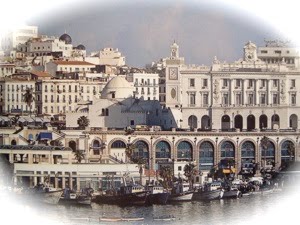 |
| The port of Algiers |
 |
| Caryatids in central Algiers |
I was fortunate enough to take a whole-day excursion through some of Algeria’s most breath-taking scenery to the oasis town of Biskra, situated on the northern fringes of the Sahara. My journey south took me through the Aurès Mountains and the gorge of Tighanimine to Biskra, gateway to the desert, where a local family invited me to eat in their private palm grove. En route I visited the abandoned canyon village of Rhoufi and passed through El Kantara, once known as Calceus Herculis (Hercules' Boot).
I’m now back on the coast, at the Hotel Safir, once the favoured haunt of Charlie Chaplin, of all people, overlooking the Bay of Algiers. It’s comforting to be back here - it’s familiar territory to me - but, as I’ve said elsewhere, everyone should have the chance to step foot in the Sahara at least once during their lives.
 |
| The mark of Baron Haussmann is alive and well in Algiers |
 |
| The Bay of Algiers |
Over the coming weeks I hope I’ll be able to write a little more about some of the towns I’ve visited and the people I met.
Monday, February 2, 2009
I am the great lion of the day
Part of Culturissma's monthly schedule is to brief our clients on up-coming art exhibitions so that they can steal a march on their rivals. We've just got wind of a new offering at London's Tate Britain, Turner and the Masters, which will be the first ever exhibition to examine the influence of the Old Masters on J M W Turner. As well as displaying some of Turner's most scintillating canvases, Turner and the Masters will showcase around 100 works by Canaletto, Poussin, Rubens, Rembrandt and Constable.
Born in 1775, Turner - the London-born son of a barber - was always confident of his abilities, once proclaiming: "I am the real lion. I am the great lion of the day". The Tate exhibition will investigate the complexity of Turner's obsession with the Old Masters as he strove first to imitate, then rival and finally surpass the style of Rubens, Rembrandt and Claude Lorrain. Acts of homage will hang alongside sophisticated forms of art criticism in an exhibition that is likely to re-establish Turner's reputation as the greatest painter of landscape in the European tradition.
Friday, January 2, 2009
Pierre-Auguste Renoir in Paris
 |
| One of Renoir's former homes in Montmartre, with the Sacré Coeur in the background |
Lodged on the corner of our narrow lane is the pink façade of the famous Lapin Agile bistro, where the likes of Picasso, Utrillo, Derain, Braque and Modigliani once held court. It’s in this bar, formerly known as the Cabaret des Assassins, that a donkey once painted a canvas - Sunset on the Adriatic Sea - that ended up being hung in the prestigious annual Salon des Independents! It’s a lovely spot, too, to open a bottle of wine in the early evening in summer, as the sun comes streaming down the hill.
Picasso is never far from our thoughts here in Montmartre: to reach my local bar, I meander down the southern slopes of the hill past the Laundry Boat - Le Bateau Lavoir - where he once lived and painted. There's another, more personal, connection, too: I bought my apartment from a chap - the make-up artist for President Mitterand's wife, as it happens - whose new next door neighbour, just five minutes away, is Picasso's former lover and the mother of his children, Claude and Paloma. Her name is Francoise Gilot and, though Picasso died in 1973, Mme Gilot is still very much alive and kicking - and painting, too, as she is a celebrated painter in her own right.
Anyway, at the moment Culturissima is busy setting up two art tours for a major British client, a company that runs cultural and historic programmes across the world. The first tour is called "In The Footsteps of The Impressionists" and the second, "Renoir in Paris".
The latter has been timed to coincide with a Renoir retrospective, Les Dernières Années, that will be held at the Grand Palais, just off the Champs Elysées, at the end of 2009. This exhibition, details of which have yet to be released to the general public, will concentrate on the final period of Renoir's life when his nudes, later to influence Bonnard, Matisse and Picasso, drew their inspiration from the Old Masters.
 |
| Renoir's house in autumn, with the Montmartre vineyard in the foreground |
Tuesday, November 11, 2008
The Old Women and the Young Women
Culturissima has just returned from two days in northern France on behalf of one of our British clients, a travel agency based just outside Cambridge that wants to put together a tour of Lille and its environs.
What are we going to report back?
First, that Goya’s twin canvases The Old Women and The Young Women are enough in themselves to attract the art-lover to northern France. Yet Lille, where Flemish tradition meets French culture, and Valenciennes, the birthplace of Antoine Watteau, have many other exquisite treasures on display.
Lille’s Palais des Beaux Arts hosts the most valuable gathering of art in France outside Paris - not just the magnificent Goyas but also an outstanding collection of Old Master pictures and sculpture with work by Donatello, Rubens, van Dyck and Jordaens. The galleries also house an impressive selection of French 18th and 19th century gems with major œuvres by Jacques-Louis David. A short distance away lies the 13th century Hospice Comtesse, hung with 15th to 18th century paintings together with tapestries by Guillaume Werniers.
Valenciennes’ Musée des Beaux Arts pays ample tribute to the creative talent of the town’s two most famous sons, Watteau and Jean-Baptiste Carpeaux. The museum is also the setting for a notable group of Flemish 17th century paintings, in particular Rubens triptych of St Etienne and Descent from the Cross.
The focal point of our afternoon in the cathedral town of Tournai was the Musée des Beaux Arts, designed by the Belgian art nouveau architect Victor Horta. The museum’s holdings stretch from the early Flemish tradition to Monet and Seurat. And our final day was spent re-visiting the Museum of Modern Art in Villeneuve d’Ascq, set in a verdant sculpture park and endowed with prized work by Picasso, Braque, Modigliani and Miro.
What are we going to report back?
First, that Goya’s twin canvases The Old Women and The Young Women are enough in themselves to attract the art-lover to northern France. Yet Lille, where Flemish tradition meets French culture, and Valenciennes, the birthplace of Antoine Watteau, have many other exquisite treasures on display.
Lille’s Palais des Beaux Arts hosts the most valuable gathering of art in France outside Paris - not just the magnificent Goyas but also an outstanding collection of Old Master pictures and sculpture with work by Donatello, Rubens, van Dyck and Jordaens. The galleries also house an impressive selection of French 18th and 19th century gems with major œuvres by Jacques-Louis David. A short distance away lies the 13th century Hospice Comtesse, hung with 15th to 18th century paintings together with tapestries by Guillaume Werniers.
Valenciennes’ Musée des Beaux Arts pays ample tribute to the creative talent of the town’s two most famous sons, Watteau and Jean-Baptiste Carpeaux. The museum is also the setting for a notable group of Flemish 17th century paintings, in particular Rubens triptych of St Etienne and Descent from the Cross.
The focal point of our afternoon in the cathedral town of Tournai was the Musée des Beaux Arts, designed by the Belgian art nouveau architect Victor Horta. The museum’s holdings stretch from the early Flemish tradition to Monet and Seurat. And our final day was spent re-visiting the Museum of Modern Art in Villeneuve d’Ascq, set in a verdant sculpture park and endowed with prized work by Picasso, Braque, Modigliani and Miro.
Subscribe to:
Posts (Atom)